
From Plantations to Corporations: The Business of Forced Labor

“You just sell it like you were selling cars or real estate or hamburgers.”
ALL THIS HAPPENED, MORE OR LESS is independent political and history journalism for anyone interested in information about how reality got here without sponsors.
»Consider buying me breakfast or coffee on Ko-Fi/PayPal, or leaving me a small tip on Venmo.
« Contact me at juno.stump@gmail.com if you need someone with experience in mock reviews, copy editing/writing, PR work, etc »
Words, research, and edits: Juno Rylee Schultz (she/her)
Research: Kylie Tuinier (she/her)
Edits: Bex Stump (she/her) and Nathan Thatcher-Miller (he/him)
The United States refused to relinquish slavery when the 13th amendment passed in 1865, and so the system continued disguised as rehabilitation and was publicly traded on the stock market. The updated and secluded framing of suffering would be worse in many ways, but the government and corporations were driven mad with greed by the fundamentally immeasurable loop of profits.
Terrell Don Hutto pursued a career in the prison system in 1967, after serving two years in the military and earning his degree in history and sociology at East Texas State University, with Hutto’s experience and previous positions allowing him to quickly become promoted to the position of Warden in the same year of starting.
American Prison author Shaun Bauer astutely points out that during the same year “Hutto and his family settled into their plantation home in 1967, All You Need is Love by The Beatles was a new hit, and the Huttos might have listened to it in their living room while their ‘houseboy’ cooked and served them.”
“Houseboys” were a live-in perk offered to personnel at the Texas Department of Corrections to “attract the type of men who could do the job.”
Bauer explains how “houseboys were prisoners, almost always black; they made the beds, cleaned, and babysat children. The regulations of houseboys echoed the fears of slaveholders toward their house slaves. Policy prohibited Hutto’s wife from conversing with houseboys or being overly ‘familiar’ with them. Houseboys were prohibited from washing her underwear. Joking with houseboys was banned, as was allowing them to sit with the family to listen to the radio or watch television, for fear it would lead to impertinence. Hutto would live as the master of this and other plantations for a decade, distinguishing himself by making some of them more profitable than they’d been before he took charge.”
After leaving his position as the warden at the Ramsey Prison Farm, Terrell Don Hutto would go on to co-found the Corrections Corporation of America (CCA), now called CoreCivic–one of the largest for-profit detention centers in the United States.
When CCA went up on the NASDAQ stock exchange in 1986, the price went public at $9.00 per share. This was while the company was running four facilities. Nearly fifty years later, in 2025, CoreCivic operates over sixty prison facilities with a stock share price of $20.00.
This is the story of the business of forced labor in America.
In 1718, England passed the Transportation Act to “improve the colonial plantations and make them more useful to his majesty” by allowing anyone convicted of various forms of theft–at the choice of the court system–to be sent to the American colonies for up to seven years.
Felons would often beg to be exiled to America to avoid being put to death, with “some fifty thousand” felons having been sent to the American colonies between 1718 and 1775.
After winning the American Revolution, Thomas Jefferson had the idea of swapping out the death penalty for “penal slavery.”
Most reformers liked Jefferson’s idea, with many of them being wealthy, religious people, and held the belief that “crime was caused not by poverty, but by a lack of a work ethic.”
In 1786, Pennsylvania was the first state to set up anyone convicted of “lesser felonies” with “continuous hard labor, publicly and disgracefully imposed.”
Although it was initially unpopular and unsuccessful, sentenced individuals were put to work on Pennsylvania’s mines, roads, streets, and highways. A group of convicts working the roads attempted to rob Alexander Hamilton and his wife, causing a lot of anxiety amongst the powerful and wealthy.
It quickly became a distressing situation until it was decided by many that the issue with the forced labor was it being public and visible to other people. Beyond the concern for incidents similar to the robbery attempt, there was speculation that working class people may begin to see work as a punishment, instead of as an opportunity.
In 1795, Pennsylvania opened up the first state penitentiary, the first type of prison institution designed for long-term captivity. The penitentiary wasn’t profitable at first, even with Pennsylvania contracting inmate labor for some products, until 1825, when a facility in Auburn, New York had the idea of leasing convict labor to private interests.
The initial fears of unruly penitentiaries–from riots and prisoners intentionally destroying materials–were quickly put to rest by Auburn’s strict systems of control. Prisoners were forbidden from speaking to each other, enforced via whipping. This also including working slowly.
By 1831, Auburn and other state penitentiaries were routinely making profits, upwards of a few hundred thousand dollars per year in some cases, when adjusted for inflation. Instead of fizzling out, like it almost had a few years earlier, the state prison expansion continued, now that privatization and states combined had found a way to make cents of it.
In American Prison, Shane Bauer writes about how the French monarch sent Alexis de Tocqueville and Gustave de Beaumont to “assess America’s new penitentiary system” and their feedback was nothing but praise.
“The silence within these walls is that of death. We felt as if we traversed catacombs; there were a thousand living beings, and yet it was a desert solitude. The contractor, regarding the convict as a labouring machine, thinks only how he can use him to the greatest advantage for himself. He sees nothing but a money affair in such a bargain and speculates upon the victuals as he does the labour; if he loses upon the clothing he indemnifies himself upon the food; and if the labour is less productive than he calculated upon, he tries to balance his loss by spending less for the support of the convicts, with which he is equally charged.”
Mercy is ultimately the antithesis of maximizing profits, and prisons could always cut meals to make sure budgets balance out and profits are extracted to a maximum.
The atrocities escalated as private companies and states began seizing on what their eyes perceived as limitless possibilities for making money.
By 1841, the Louisiana State Penitentiary was being praised by newspapers as a “model for private slave-holders” with its “sunrise to sunset” around the clock, cotton-and-shoe production lines. Everything was monetized.
As Bauer states in American Prison, “For a twenty-five cent entrance fee, visitors could come and watch the convicts spinning cotton, making cloth, and pounding steel. Citizens could buy prisoner-made products at a discount in a store across the street.”
The media was also excited about the effectiveness of the prison labor. According to Bauer, one reporter at the time was especially excited about how clean and quiet everything was, saying:
“The first thing that strikes one on entering the gates of the penitentiary is the cleanliness everywhere observable, next, the systematic order that obtains; and next, the silence.”
In 1844, Louisiana would privatize the same penitentiary–for reasons largely related to budget cuts–”leasing it to a company called McHatton, Pratt & Ward.”
According to Bauer, the state didn’t charge the company anything at first, “but the company was responsible for the operations of the prison, including feeding and clothing inmates.”
McHatton, Pratt & Ward were allowed to use the labor of inmates for whatever they wanted, as long as they also handled the operations of everything.
This arrangement changed in 1850 however, with Louisiana charging the company “one quarter of its profits.”
By 1857, it would be half the profits–all extracted from routine human suffering that was considered lawful rehabilitation.
Bauer explains that “a year” into the penitentiary being leased, it was already labeled a success by Louisiana, with politicians approving “a loan of $15,000 to increase industrial capacity.”
The changes to the penitentiary were so vast that the U.S. military utilized the Louisiana State Penitentiary “for the Mexican War effort” to “produce some twenty-four thousand horse and mule shoes.”
After the manufacturing capabilities expansions were completed, much more was possible, but only if the leasing company had access to more labor. The owners of the leasing company whined to the courts and politicians for putting prisoners into jails instead of the state penitentiary, “thereby depriving them of labor, to which they were entitled under the contract.”
Bauer states that no more than six years after the leasing company pressed politicians and the court system did the state penitentiary hit a 50 percent increase in inmates.
One state newspaper reportedly stated rather optimistically that “the successful introduction of cotton manufacture into our state penitentiary shows how profitable this species of industry may be made in the South … the profits of the institution are large.”
Bauer explains in American Prison that states in the south all followed in Louisiana’s lead, “opening penitentiaries of their own … some were run by the state, others were privatized, but profit, rather than rehabilitation, became the guiding principle of all.”
The state penitentiary prison system began to be a guiding hand for industrialization and a normal part of the region’s economy, as slavery in a different name had once been.
The cruelty and methods for extracting money from inmates knew no bounds at the Louisiana State Penitentiary; a law was passed in 1848 that made any children born inside the state penitentiary “of African Americans serving life sentences” state property.
Making the prison rape of mothers and sales of their children even worse, the mothers were forced to raise the children until the age of 10. Once the children who were considered state property reached that age, an ad would be placed in the newspaper by the penitentiary. The auctions would be completed on the courthouse steps within thirty days.
The money from all the sales of Black children were used to fund schools for white children, providing more opportunity to white families while depriving entire futures to black families.
Most of the records that remain only include financial details–the mother’s names often not even being noted–so we know from the receipts that “Louisiana made $7,591 from the enslaved offspring of incarcerated mothers.”
Adjusted for inflation, that’s over $250,000 in today’s dollars.
When the Civil War ended, the state of Louisiana decided to lease the entirety of the Louisiana State Penitentiary population to Samuel Lawrence James, a former major in the confederate army. James had plans to return to slavery era levels of production–and profits–which was already happening in other areas of the south.
As Bauer writes in American Prison:
“In Mississippi, “Cotton King” Edmund Richardson convinced the state to lease him its convicts. He wanted to rebuild the cotton empire he’d lost during the war and, with its penitentiary burned to ashes, the state needed somewhere to send its prisoners. The state agreed to pay him $18,000 per year for their maintenance, and he could keep the profits derived from their labor. With the help of convict labor, he would become the most powerful cotton planter in the world, producing more than twelve thousand bales on fifty plantations per year.”
Bauer explains how Georgia leased its convicts to “a railroad builder” and Alabama leased its convicts “to a dummy firm that sublet them for forced labor in mines and railroad and construction camps throughout the state.”
Louisiana wanted to do the same thing, and saw no reason not to take it a little further, attempting to have the agreement benefit Louisiana even more.
James would pay the state $100,000 at the beginning of the lease, in addition to $5,000 for the first year, and $1,000 more each year, until it reached $25,000 for the twenty-fifth year of the lease. Louisiana made bank on the annual flat rates, and James worked his state-sanctioned slaves all around the state, keeping every dollar made.
The factory Samuel Lawrence James had built for his slave labor workforce was literally so big that Louisiana newspapers were excited about how much it would “stimulate Louisiana’s economy by increasing demand for cotton, wool, lumber, and other raw materials.”
It wasn’t enough though. James had more manufacturing capabilities than he possessed in forced labor. To solve this problem–and to keep his three-story factory open 24/7–Samuel Lawrence James “imported 150 Chinese laborers in 1871.”
They were paid “$22 a month in gold” and worked from early evening until sunrise–daily.
There was some grumbling about it, from politicians and people who were meant to be regulators, as the Reconstruction era happened across the backdrop of the south–but the profits were soaring enough to continue purchasing anything resembling morals for states and would-be regulators across the country.
According to Shane Bauer in American Prison, “Georgia, Mississippi, Arkansas, North Carolina, and Kentucky were making between $25,000 and $50,000 each year. Alabama and Tennessee were bringing in around $100,000 annually.”
By 1890, nearly thirty thousand prisoners were performing labor in the south, and states were increasingly passing legislation that kept the supply of enslaved Black men–and the systems of control and white supremacy–in an upward trajectory.
One such example was the passing of the Pig Law in Mississippi in 1876, which automatically assigned five years of forced labor for any theft of a farm animal–or anything worth ten or more dollars. According to Bauer, this “quadrupled” the number of state convicts in only three years.
Convicts were routinely assigned dangerous and deadly work that no one else wanted to do, and safety precautions were often ignored entirely.
A horrific example of this in practice is perhaps best illustrated through Mississippi leasing convicts to railroad companies, where men were nearly nude in knee-deep swamp water, chained at their feet. The men weren’t given different water to drink from, and they were not allowed to leave to use the bathroom.
According to Bauer’s American Prison, “a grand jury testimony, from a few years later, reported seeing inmates with consumption and other incurable diseases. Most of them [with] their backs cut in great wales, scars, and blisters, some with the skin peeling off in pieces as a result of the severe beatings.”
One person on the jury said, “They are lying there dying, some of them on the bare boards, so poor and emaciated that their bones almost come through their skin, many complaining of want of food. We actually saw live vermin crawling over their faces, and the little bedding and clothing they have in tatters and stiff with filth.”
We don’t have any accounts from any of the men who endured these events, so we only have the words of those who decided it was acceptable business, and the words of those who decided it was horrifying.
According to Bauer’s American Prison, a southern man in 1883 articulated the grim situation most astutely, when speaking to the National Conference of Charities and Correction, saying:
“Before the war, we owned the negroes. If a man had a good negro, he could afford to take care of him: if he was sick get a doctor. He might even put gold plugs in his teeth. But these convicts: we down own ’em. One dies, get another.”
Not only did states keep the supply of convicts going steady to their lease purchasers, regardless of death, cruelty, or incident: states also didn’t give penalty or fines, or do anything at all.
Everything just kept going, from the systems of cruelty to the money made by those responsible.
One case of this was with the Tennessee Coal, Iron and Railroad Company (TCI), where its 15,000 plus convicts were subjected to inhuman conditions beyond full description and comprehension.
According to Bauer, enslaved convicts spent “the bulk of their waking days underground, sweating in the suffocating warrens of coal mines … crawled into narrow crevices, laid on their backs, and hacked at the walls, trying to free huge slabs of coal.”
Nearly twenty percent of those subjected to forced labor on behalf of TCI in Alabama died in 1889, sometimes from “coal slabs, weighing half a ton or more” falling on top of “inexperienced convict miners.”
After being trapped underground for weeks at a time with barely enough air to breathe, miners would lose their sanity and attack each other with their pickaxes, explosions from clearing debris would lead to inmates being crushed, and if they were able to survive all of these circumstances, guards would execute convicts without cause or reason.
Fires set by convicts trying to escape would also spread through tunnels, adding further risk.
Dead convicts were simply tossed in with the debris and the work continued.
An Alabama health inspector wrote about the conditions at one of the mining camps, which can be found in Shane Bauer’s American Prison, saying: “[The drinking water] is a water that no population of human creatures inside or outside of the prison walls should be condemned to drink.”
Still, the health inspectors would often find a way to attach the blame for everything “on the debased moral conditions of the negro whose systems are poisoned beyond medical aid by the loathsome diseases incident to the unrestrained indulgence of lust … now that they are deprived of the control and care of a master.”
The US Commissioner of Labor in Alabama endorsed the system, calling “convict labor more reliable and productive than free labor.”
The Commissioner of Labor also attributed the growing success of the mining industry to forced labor, saying “mine owners could not work at a profit without the lowering effect in wages of convict-labor competition.”
In 1907, TCI was purchased by US Steel Corporation, becoming “one of the biggest transactions in the history of US capitalism to that date.”
According to Bauer, “the merger was brokered by J.P. Morgan [and] created a virtual monopoly for USS.”
In 1908, the new company “signed a contract with Jefferson County, [paying] nearly $60,000 to acquire every prisoner arrested that year.”
TCI would continue using convict labor for at least another twenty years, but the company would distance itself from the use of convict labor, when discussing the company’s 100-year history, in a book released by TCI in the 1960’s.
According to Shane Bauer, “when Douglas Blackmon, author of Slavery by Another Name, contacted USS [about the use of convict labor missing from the company’s official histories], executives told him it was ‘not fair’ to assign responsibility for a corporation’s actions so long ago.”
Today in 2026, US Steel Corp has a market cap of 12.42 billion, and their shares are publicly traded at $54.84 a share.
Convict leasing would start to wind down once a twenty-two year old white man, named Martin Talbert, disappeared and died inside of the system. His middle class family had the means to pursue the situation legally once it was found out and determined that, after being picked up under false vagrancy pretenses, Talbert had been murdered by a guard while working in a swamp.
As the story picked up national attention, it was learned by the family’s attorney and the investigating Florida legislature that the Leon County sheriff had “made an agreement with Putnam Lumber” and that “the number of people arrested as vagrants for riding a train without a ticket multiplied eightfold.”
It also came out from “a former Leon County jailer” that the sheriff had been “railroading” people into the convict leasing system “for a sizeable profit” while “men charged with vagrancy were brought before inebriated court officers, without lawyers, late at night, and regularly found guilty.”
Shane Bauer reports “the Talbert family sued the Putnam Lumber Company, which settled out of court for $20,000, in exchange for a public statement from the family that the company was absolved ‘of all willful blame.’
The officer was charged with murder and convicted, though it was overturned on a technicality. He later beat, killed, and shot another convict lease worker–a Black worker this time–and was allowed to miss the court date because of health issues. According to Bauer, “there was no further attempt to punish him” for any of his crimes.
Some things never change.
Florida would finally stop and end convict leasing in 1923, after mass consumer boycotts against Florida manufactured goods. It was one of the last states to use convict leasing in the original matter, with the attention from the death of Martin Talbert being a major reason for its end.
Though as Bauer artfully points out: “as states phased out convict leasing in the early twentieth century, did the prisoners notice?”
Chain gangs and work projects for Georgia, Mississippi, Florida, North Carolina, and many other states in the south began to take the place of convict leasing.
Black men were still being hung, whipped, beaten, killed, and forced to work for minor crimes. It just took on a different name.
Some things never change.
Many prisons in the south from the 1940s and into the late 1960s became state-run plantations, like “the sixteen thousand acre Cummins, Arkansas plantation” which had prisoners working around the clock “growing crops like cotton, rice, and strawberries.”
According to Shane Bauer, “farms brought an average of $1.4 million per year in revenue, adding hundreds of thousands of dollars in profits to the state treasury.
In 1971 when Governor Dale Bumpers selected Terrell Don Hutto to serve as the warden at the Arkansas Department of Corrections, Hutto specifically requested to live on the plantation itself–a highly unusual move.
Within a year of arriving and taking over, Hutto had all sorts of ridiculous money-making ventures, such as when he sold tickets for crowds to watch prisoners try to steal a packet of tobacco from “between the horns of an enraged bull”, or to watch prisoners try to grab a greased pig.
Hutto made an assortment of changes to how the prison itself was run, with a big focus on creating a profitable prison. According to Shane Bauer, “during Hutto’s first year in Arkansas, farm operations totaled nearly $1.8 million in revenue, half a million more than the year before.”
Conditions for inmates became worse as well, but Governor Dale Bumpers was “satisfied with Hutto, telling reporters it appeared the inmates worked harder for Hutto than they did for his predecessor.”
Still, by 1974, courts were beginning to find issues with the state of Arkansas and Hutto providing a “constitutional and, in some respects, even a humane environment.”
One judge referred to the conditions under Hutto as “sub-human” and specifically referred to torture being used within the facility, as well as several other issues, including “an abuse of solitary confinement” and “a lack of adequate medical care, including basic emergency services.”
In 1983, Terrell Don Hutto co-founded the Corrections Corporation of America with his “two old college roommates”; together Don Hutto, Thomas Beasley, and Dr. Robert Crants “converted a motel into an immigrant detention center in Houston” before building “another one from scratch.”
The three men continued selling their privatization pitch to states, with the idea of states being able to continue prison expansion “without taking on new debt.”
As Thomas Beasley told Inc. magazine: “You just sell it like you were selling cars or real estate or hamburgers.”
According to Shane Bauer’s American Prison, “early investors included Sodexho Marriot, and the venture capitalist Jack Massey, who helped build Kentucky Fried Chicken, Wendy’s and the Hospital Corporation of America.”
In the beginning, CCA was only running a handful of centers, but by 2017, the publicly traded corporation would be running “more than eighty facilities” including “state prisons, jails, residential re-entry facilities, and federal immigration centers.”
The 1980s and 1990s would feature massive expansions for prisons, prison populations, and those benefitting from the profits and systems of control, largely in part from the 1986 Immigration Reform and Control Act.
As Nancy Hiemstra and Deirdre Conlon explain in Immigration Detention Inc. The Big Business of Locking Up Migrants:
“In the early 1980s, public panic rose over escalating Cuban, Haitian, Mexican, and Central American immigration. In response, Republican President Ronald Reagan adopted a new policy of detaining more asylum seekers from these places. Reagan also required the U.S. to permanently keep available 10,000 detention beds. [When] existing government-owned detention facilities were overcrowded, the Immigration and Naturalization Service (the INS, the precursor to today’s ICE) contracted space with private prison operators and local governments.”
CCA (known today as CoreCivic) and other for-profit, private, prison corporations stepped in to assist the government with this task.
In 1996, the Illegal Immigration Reform and Immigrant Responsibility Act and the Antiterrorism and Effective Death Penalty Act both “greatly expanded the categories of immigrants subject to mandatory detention and deportation.”
The laws also made it easier to deport citizens, while “significantly adding to the list of deportable acts” and making it “harder to fight deportation.”
According to Hiemstra and Conlon’s Immigration Detention Inc., “by the end of Bill Clinton’s administration detention capacity was up to almost 20,000.”
The Homeland Security Act of 2003–which came with the Patriot Act after the September 11th terrorist attacks–created the Department of Homeland Security, and “replaced the INS with the scaled-up, bigger-budget Immigration and Customs Enforcement (ICE) agency.”
There were obvious intentions from the onset, but proof came in the laws passed next as well, with the “2004 Intelligence Reform and Terrorism Prevention Act mandating that ICE increase detention capacity by 8,000 each year from 2006 to 2010.”
The Obama administration provided even more protections and powers to ICE, which included “an annual detention bed quota in yearly funding bills, requiring that ICE make sure that there was a standing nationwide detention capacity for at least 34,000 individuals.”
Hiemstra and Conlon both state that the Obama administration’s policies were “driven by the idea that harsh and harmful enforcement policies deter future immigration, despite the continued lack of evidence to support this assumption.”
In reality, however, these increased detention quotas all came at the same time as other incarceration rates began to slow. It was essentially very close to what happened in Leon County and the Sheriff shuttling vagrants into Putnam Lumber Company–except now it was the Federal and State governments, and immigrants who were de-humanized in the eyes of much of the general public, and unable to afford legal representation.
By 2017, once Donald Trump was president, ICE and the federal government started going after “more settled immigrants” as well as intentionally separating children from parents. As all of this happened, it also intentionally became harder for immigrants to be granted asylum.
The business of forced labor will only continue to grow as systems of power and private companies both stand to benefit from imprisoning specific groups of people for power and control.
In 1994, the federal budget for detention was $8 million; by 2024, that same federal budget was set at $3.1 billion.
Together we can create an empathetic world.
I would like to end this piece with a call to action and the only words of hope I can think to share while reflecting on our history and future of love and suffering as humans in this world together:
“The burden belongs to the nation, and the hands of none of us are clean if we bend not our energies to righting these great wrongs” – W. E. B. Du Bois, 1903
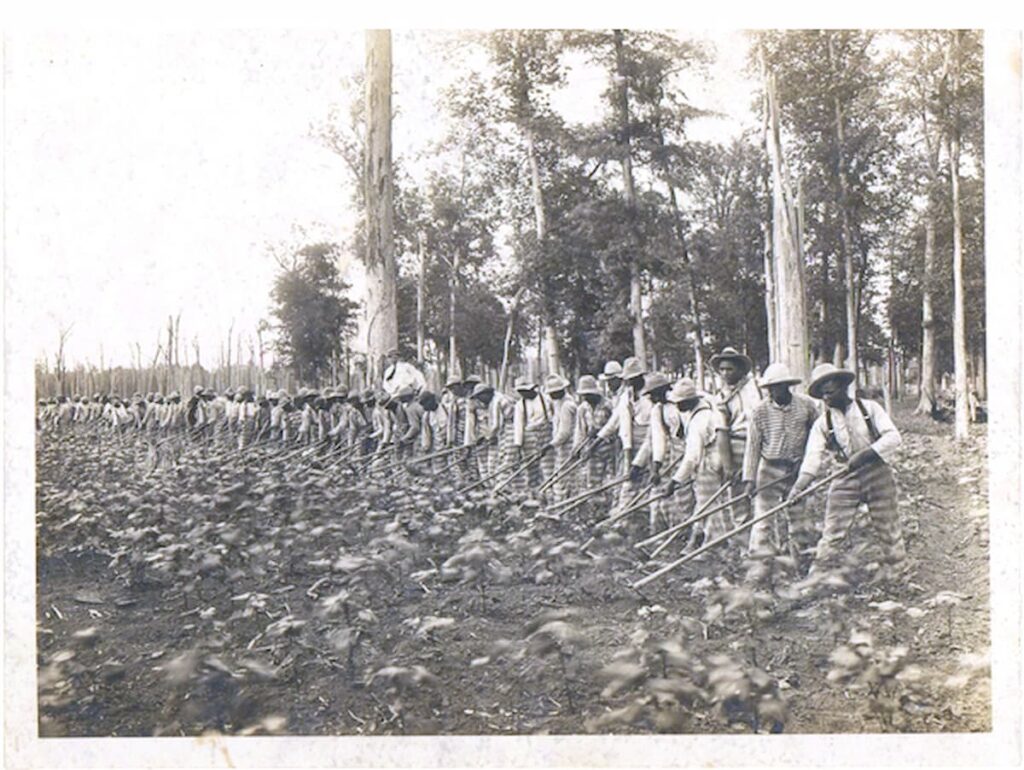
Note from the author: I typically source images for the body of pieces, but this journalism piece was already extremely hard for me–emotionally and mentally–and I needed to just do a single, sourced image at the top. Thank you for understanding.
Sources: American Prison: A Reporter’s Undercover Journey into the Business of Punishment by Shane Bauer (2018), Immigration Detention Inc. The Big Business of Locking Up Migrants by Nancy Hiemstra and Deirdre Conlon (2025)
Photo Credit: ‘Prisoners at Parchman Penitentiary hoeing in a field in the early 20th century.’ PBSNews, from the Archives and Records Services Division, Mississippi Department of Archives and History
Tags: All This Happened, ALL THIS HAPPENED MORE OR LESS, CCA, Convict Labor, CoreCivic, ICE, INS, Prison, Terrell Don Hutto, US Prison System
Leave a Reply