
 Juno Rylee Schultz
“They said it was a weird little show, it wouldn’t work. It was odd. They had never seen anything like it before. “
GIRL MUSIC is independent music journalism for anyone that loves pretty art and music.
»Consider buying me breakfast or coffee on Ko-Fi/PayPal, or leaving me a small tip on Venmo.
« Contact me at juno.rylee.schultz@gmail.com if you need someone with experience in mock reviews, copy editing/writing, PR work, etc »
Words, research, and edits: Juno Rylee Schultz (she/her)
Research: Kylie Tuinier (she/her)
Edits: Bex Stump (she/her), Kylie Tuinier (she/her), and Nathan Thatcher-Miller (he/him)
Adventure Time is a magical show that has touched the hearts of countless people, but it took an incalculable amount of work to craft, especially its first season, when characters, setting, and tone were still being constructed.
And then it took months of work for each string of ideas to be assembled into animated and fully voiced episodes.
This is the story of how Adventure Time went from an idea Pendleton Ward had in college to the airing of its first completed season.
“I came in with a goofy little idea that I had drawn up in my sketchbook. I didn’t know what a professional storyboard was supposed to look like, or how to draw one. I did the best I could. I wrote a song about it that I sang at the meeting, and that song is the opening credit song that ended up in the beginning of the pilot and series.”
— PEN WARD, Adventure Time: The Art of Ooo (2014)
Pendleton Ward was an introverted and creative kid, born in 1982 in San Antonio, Texas. His mother, Bettie Ward, was also an artist, and so she encouraged Pendleton’s interest “at every possible opportunity.”
According to Paul A. Thomas, from Exploring the Land of Ooo, Pendleton developed “an intense fixation” with cartoons and animation, even making small flipbooks of his own, while “dreaming of the day he could develop his own cartoon.”
Thomas remarks on how Ward was glued to the TV screen during all kinds of cartoons during the 1990’s, with The Simpsons being one of his favorites. Ward’s imagination was irrevocably expanded as a teenager once he became obsessed with the storytelling of Dungeons & Dragons with his friends.
According to Thomas in Exploring the Land of Ooo, Pendleton further “developed his drawing abilities at North East School of the Arts” where he left an impression with many of his teachers “as an excellent artist and creative freethinker.”
In 1999 and 2000, Ward attended a Summer program at CalArts. He would later attend fully from 2001 to 2005, earning a bachelor’s degree in Character Animation. It was during this time where Ward would meet many artists who he would later invite to work on Adventure Time, including Patrick McHale and Adam Muto.
“Pen and Adam were both a grease above me at CalArts. I learned about Pen because some people told me that my drawings looked like Pen’s drawings, except his stuff was funnier than mine … I forget how we actually became friends, but we used to doodle and draw comics. We just got along really well and had a lot of similar tastes/interests…
We had a similar sense of humor and stuff. For instance, one thing we bonded over was that we tried to create a real-world role playing game called LifeQuest in which players walk around parking lots to fight monsters by flipping pennies.”
– Patrick McHale, Exploring the Land of Ooo: An Unofficial Overview Production History of Cartoon Network’s Adventure Time, Paul A. Thomas (2023)
“Adam was infamous at CalArts for being this incredible animator who would animate all day and night, but would never complete a film. Once I got to know him I realized he was just less interested in finishing a film than he was in exploring the possibilities of animation. It’s hard to describe, but looking at Adam’s animation made me realize that your animation didn’t have to just be entertainment or art, but it could also be literature, poetry, or philosophy, or science or something …
He was almost like an animation scientist, just pushing the boundaries and testing hypotheses. Not for any purpose other than the pursuit of truth in animation. Adam animated some of Pen’s wall doodles one time, which was incredible to see; at the time I hadn’t really seen simple cute drawings being animated in that way. “
– Patrick McHale, Exploring the Land of Ooo: An Unofficial Overview Production History of Cartoon Network’s Adventure Time, Paul A. Thomas (2023)
According to Thomas from Exploring the Land of Ooo: “Ward’s student work at CalArts was … rough around the edges but … he made up for it with creative verve and a one-of-a-kind sense of humor.”
Adam Muto noted in a 2014 interview with Rolling Stone that “even back then [at CalArts], Ward’s films were the funniest ones being made.”
According to Paul A. Thomas from Exploring the Land of Ooo, “One of these films (created in 2005) was a minute-long short that featured two heroes–a boy and his dog–rescuing “Princess Bubblegum” from the clutches of a wicked “Ice King.”
“It was just a sketch I kicked into a minute-long short. Nickelodeon was taking pitches from CalArts students. And they didn’t like it.”
– Pendleton Ward, interview with Los Angeles Times, (2018)
According to Paul A. Thomas, even though Nickelodeon was “indifferent” to Ward’s work, “others were starting to take notice, including Eric Homan, the development executive at Frederator Studios.”
“Every spring CalArts holds its Producers’ Show, a screening showing off the best of the year’s student animated work. Pen’s senior film in 2005 was a big hit with both the audience and his classmates (and with me, of course, like everyone else, I found Pen’s work to be funny, good-hearted, and wildly distinctive–like Pen himself). At Frederator Studios we had just begun taking pitches for a shorts show we were producing for Nickelodeon, Random! Cartoons. At the Producers’ Show I encouraged Pen to pitch.”
– Eric Homan, Exploring the Land of Ooo: An Unofficial Overview Production History of Cartoon Network’s Adventure Time, Paul A. Thomas (2023)
Ward had now graduated from CalArts and decided to travel to Nickelodeon. His plan was to pitch the show again. He gave a very spirited pitch, even performing a rough version of what would become the Adventure Time intro song.
According to Paul A. Thomas, “The folks at Frederator enjoyed the pitch, but many … were apprehensive about Ward’s work, fearing that it was too unpolished.”
“I saw the pitch, loved it, and then said we weren’t going to do the cartoon. At the time I’d been making cartoons for, like, 15 years, and like every other idiot executive, I thought I knew what made a good cartoon. And this did not fit on the surface.”
– Fred Seibert, interview with Dom’s Sketch Cast (2013)
But Homan and Frederator’s vice-president Kevin Kolde “continuously pressed Seibert to take a chance on Ward.”
Finally, after “a one-on-one meeting with Pen,” Seibert came around and decided to start pushing for Adventure Time’s approval as well.
Up to this point, Ward had only worked on student films at CalArts, and so the opportunity to work with Frederator, an established studio that had put out shows such as ChalkZone and The Fairly Oddparents, was a big deal.
Ward was reportedly excited for the opportunity, but also worried about whether he would “sink or swim.”
To help with the task of preparing a completed short for Nickelodeon, Pendleton “enlisted the help of several CalArts friends, including Adam Muto.”
It took several months of work, but “Adventure Time was finalized in the Spring of 2006.”
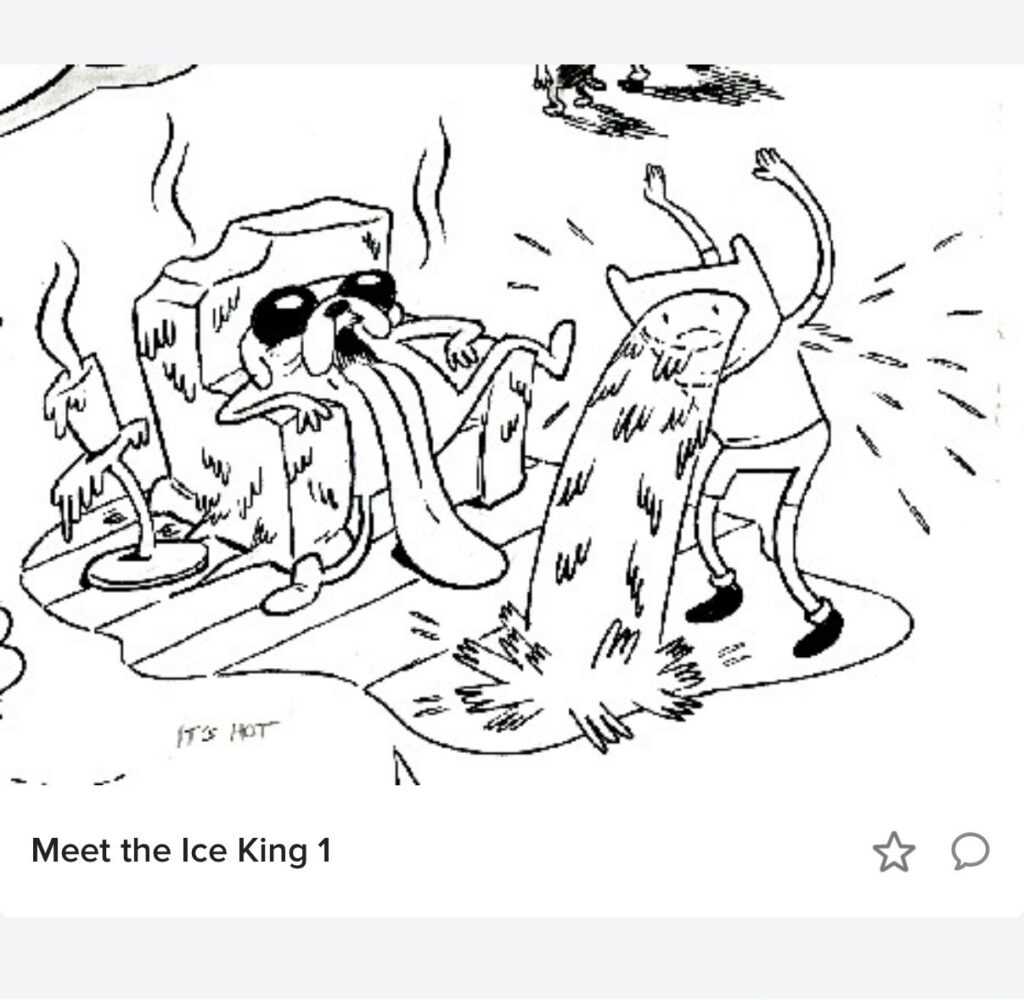
In the prepared short, a hero, named Pen, and his talking dog, Jake, fought against the Ice King to save the captured Princess Bubblegum. Pen is frozen by the Ice King but his consciousness travels to Mars, where he receives advice from Abraham Lincoln. It is then with the power of believing in himself that Pen is able to break free from the ice and save the princess.
This Adventure Time short first aired on the Nicktoons network in January 2007, and it made a big impact. According to Paul A. Thomas, this was “largely thanks to Frederator, who uploaded the short onto YouTube, in the hopes of drumming up interest.”
Fred Seibert had received approval from Nicktoons for this move, but Viacom, the owner of Nickelodeon, viewed this as a violation of copyright, and ordered it to be removed.
Though according to Paul A. Thomas, “their efforts were ultimately in vain, for each time an “illicit” upload of the short was taken down, two more took its place.”
Adventure Time quickly became a viral sensation, with everyone clicking and watching on the animated short that kept getting removed from the Internet. The buzz even led to the animated short being nominated for an Annie Award.
Paul A. Thomas writes that Frederator “took notice of all this attention” to Nickelodeon, asking if there was legitimate interest “in developing the short into a full program.”
“Nickelodeon had a two-year option to develop a series based on the short, so we asked Pen to create a document to pitch the series. I knew it would be a hard sell, and I tried to head off objections by citing what I felt would be the four reasons focus groups would not respond well. Nickelodeon came back from the groups with five objections and said no to the series. We went back four more times, all to different executives. “It’s not a Nickelodeon show.” They all said no.”
— Fred Seibert, Exploring the Land of Ooo: An Unofficial Overview Production History of Cartoon Network’s Adventure Time, Paul A. Thomas (2023)
The short would air for a final time on Nickelodeon in December 2008. Meanwhile, Pendleton got “a real job, working as a storyboard artist on The Marvelous Misadventures of Flapjack,” sensing that Adventure Time’s hopes of being picked up were gone.
According to Paul A. Thomas, Ward later called working on Flapjack “a crash course on how to professionally storyboard,” which gave him the rest of the skills he needed to succeed in a professional animation environment.
As this was happening, Fred Seibert continued pitching Adventure Time to different networks, after asking Nickelodeon to “cancel the deal.”
It was around this same time that Cartoon Network contacted Frederator, having seen the “Adventure Time” short on YouTube. The company was interested in developing the short into a full series, on the condition that “Pen could prove the seven-minute short made for Nick wasn’t a one-hit wonder.”
Ward immediately started working on story ideas with Adam Muto and Patrick McHale, but Cartoon Network rejected this storyboard, feeling it lacked what made the original short so special.
According to Paul A. Thomas: “Ward, McHale, and Muto dutifully retreated back to the drawing board and began dissecting the initial short in an attempt to pinpoint the elements that made it so unique.”
After isolating the parts that they believed gave the original short its special quirkiness, the three put together another storyboard for Cartoon Network.
This episode would later air as “The Enchiridion,” and it contained the random silliness and the action found in the original short, prompting Cartoon Network to order twenty-six episodes “to go into immediate production.”
According to Paul A. Thomas, “this was a highly unusual move, as most television shows go through a fairly detailed preproduction period, in which the writers and producers get a chance to figure out the show’s world, its characters, and its aesthetics.”
Cartoon Network was in a hurry however, and looking for a big hit as soon as possible.
Ward, McHale and Muto all worked together, to combine their creative sensibilities into the vision they all had in their minds.
“Ward, McHale, and Muto pretty much launched into series production at Cartoon Network with no development time given, so the writers and artists were figuring out what the show would be while they were making episodes. And since the series was so different from anything else at the time, there was a lot of anxiety on what was seen as a pretty big risk. There were disagreements about the writing process, and having a revolving door of Cartoon Network producers supervising the project early on didn’t help.”
– Eric Homan, Exploring the Land of Ooo: An Unofficial Overview Production History of Cartoon Network’s Adventure Time, Paul A. Thomas (2023)
“At the time, Cartoon Network had canceled almost all of their animated shows. They were also on the path of rebranding the network “CN” instead of “Cartoon Network” and filling it with live action shows instead of cartoons. Adventure Time was kind of the only new animated show they were making. So there was a lot of pressure for it to be the animated show and the network second guessed every decision Pen would make.
There was too much riding on it, so it’s understandable why the network was so stressed out about it, and why they couldn’t give us the benefit of the doubt. It was just unfortunate for all that it had to be so difficult in those early days.”
— Patrick McHale, Exploring the Land of Ooo: An Unofficial Overview Production History of Cartoon Network’s Adventure Time, Paul A. Thomas (2023)
“We, the executives of Frederator, fought with the network like crazy for the first year or 18 months as they demanded a variety of things that would not be in the show’s interest. From creative choices to production methods, Cartoon Network was used to bullying their creators on both the creative front and production … and the network wanted to change an amazing amount of what made the series what it was.
To them “adventure” was the opposite of a comedy, so “can’t we change the title?” “Our target demographic is boys, we can’t have girls in the show, and if we do there can’t be any kissing.” Stupid stuff like that.”
“The creative head of the network insisted that ‘artists can’t write’ (a common refrain I’ve heard from executives for thirty years, no matter how large their bonus checks were from artist-driven shows like Dexter’s Laboratory, The Powerpuff Girls, Courage the Cowardly Dog, etc ,etc) and he and I had shouting matches about it.
Eventually we settled with having a “story editor” they picked in the room. There was also objection to having a fresh score for each episode, which was indeed different than any other show we’d produced and against common practice, until Kevin Kolde found a solution that shut that down. The production department was used to controlling all of the players with arbitrary choices whether or not they were right for the project. No wonder Cartoon Network had had a very spotty record of success the previous decade. Eventually our perceived interference resulted in some of our team being banned from the CN studios.”
— Executive Producer Fred Seibert, Exploring the Land of Ooo: An Unofficial Overview Production History of Cartoon Network’s Adventure Time, Paul A. Thomas (2023)
According to McHale, Adventure Time was “constantly on the verge of falling apart,” in large part due to the network meddling, and everyone involved creatively being under so much pressure.
According to McHale, another “creative hurdle” came from “many of the people who were initially hired to work on the series” not understanding “Ward’s approach to animation, or his deceptively simple aesthetic.”
Cartoon Network “halted production,” after seeing all the production troubles, and began “hiring people with season animation acumen.”
This included Merriweather Williams, Nick Jennings, Larry Leichliter, and Derek Drymon; all of whom were animation veterans from hit shows like SpongeBob SquarePants.
From Paul A. Thomas’ Exploring the Land of Ooo: “Williams was stationed in the Adventure Time writers’ room as story editor, helping Ward and his crew break episode scripts. Meanwhile, Jennings and Leichliter were placed in directorial roles; the former used his creative eye for design to go over models, background pieces, and color palettes, whereas the latter oversaw sheet timing. Finally, Drymon was hired on as an executive producer and functioned as a creative intermediary, “telling the network what they needed to hear,” while also communicating to the production crew “what Cartoon Network was trying to say.”
It was through this new team, and “in large part to Drymon’s mediation” that Ward and the team learned what Cartoon Network was searching for: an animated sitcom.
Previously, the team was trying to make “a weird action/comedy.”
With a clear vision in place, the team moved faster with production.
Before production began, writers and producers worked out storyline issues, and made sure everything connected throughout the season. Then once these larger beats were worked out, the team focused on more granular details on individual episodes.
The entire process was so involved that it “usually took about nine months” to complete a single episode, which is part of why episodes for seasons are all put together simultaneously.
According to Paul A. Thomas: “All Adventure Time episodes originated as general outlines developed in the series’ writers’ room.”
Stories were often sketched out, “usually a page or two at most” to detail “the main acts of an episode.”
Thomas writes that “outlines were normally written by a dedicated storyline crew” and that “it was common for stories to be based on the everyday experiences of the writers.”
Some outlines came from writers playing writing games in the writer’s room together.
Other ideas came from the writers just trying to make each other laugh.
From Exploring the Land of Ooo: “Ward [says] that he and the writers simply wrote plot ideas that made themselves laugh. Sometimes an episode would revolve around an idea or visual that Ward felt “kids were really going to dig on,” and at other times, episodes focused on more complicated topics like love or death.”
“I try to stay away from gross-out humor. I like the show to be really cute.”
– Pendleton Ward, Exploring the Land of Ooo: An Unofficial Overview and Production History of Cartoon Network’s Adventure Time (2023)
Once episode outlines were finished and approved, they were sent off to the show’s storyboard artists.
Adventure Time received a lot of its writing and touches from its storyboard artists, who had a lot of input on writing and where the show went, thanks to a realization Pendleton Ward had early on.
“I sat down to write my first script … and I wrote “Finn and Jake make funny faces at each other.” I thought, “This sucks. This is not funny. I need to draw what those faces are and I need to time it out so that it feels funny.” … I scrapped the whole idea [of having the show based around scripts] and just went the storyboard driven route.”
– Pendleton Ward, Exploring the Land of Ooo: An Unofficial Overview and Production History of Cartoon Network’s Adventure Time (2023)
According to Exploring the Land of Ooo: “As a result of this decision, it was the storyboard artists, and not the storyline writers, who had most of the creative control over pacing, action, and–most importantly–dialogue.”
“They’re writing all the jokes, editing the outline, picking up the camera shows … [and figuring out] what the episode is going to look like.” Structuring the show in this way allowed the artistic personalities of the various storyboard artists to shine through in finished episodes, as storyboard artist Polly Guo explained in an interview: “Each artist had their own specific voice that contributed to the show and made it the hodgepodge of art and writing that the show ended up being.”
— Kent Osbourne, interview with the Daily Beast (2013)
Part of why Adventure Time’s visual style is so uniquely its own is from Ward and Muto seeking storyboard artists from independently produced comic books.
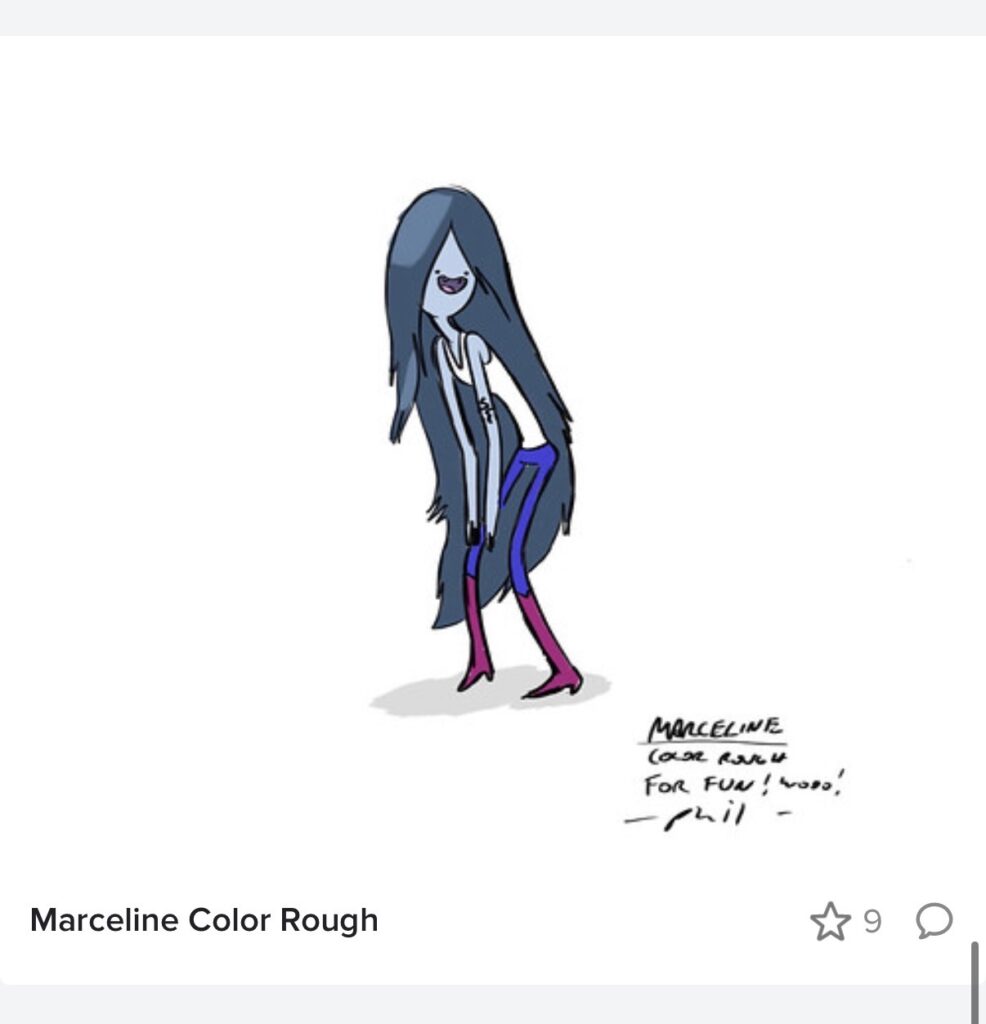
“The first season was very important to the look of the show. Phil, Tom, and [designer and storyboard revisionist] Natasha [Allergi] all helped create the visual language of how we handle clouds, hair, rocks, explosions, water, bruises, etc. … Everything in the show is modeled after what they did in season one, whether it’s ‘That’s how we do things’ or ‘That’s not how we do things’”
— ANDY RISTAINO, Adventure Time: The Art of Ooo (2014)
“On the first season, especially, we asked for a lot of concept drawings from the designers whenever they had the chance. Maybe partially because the look of the show was still evolving and we didn’t have a firmly established idea of what the characters were ‘supposed’ to look like”
— ADAM MUTO, Adventure Time: The Art of Ooo (2014)
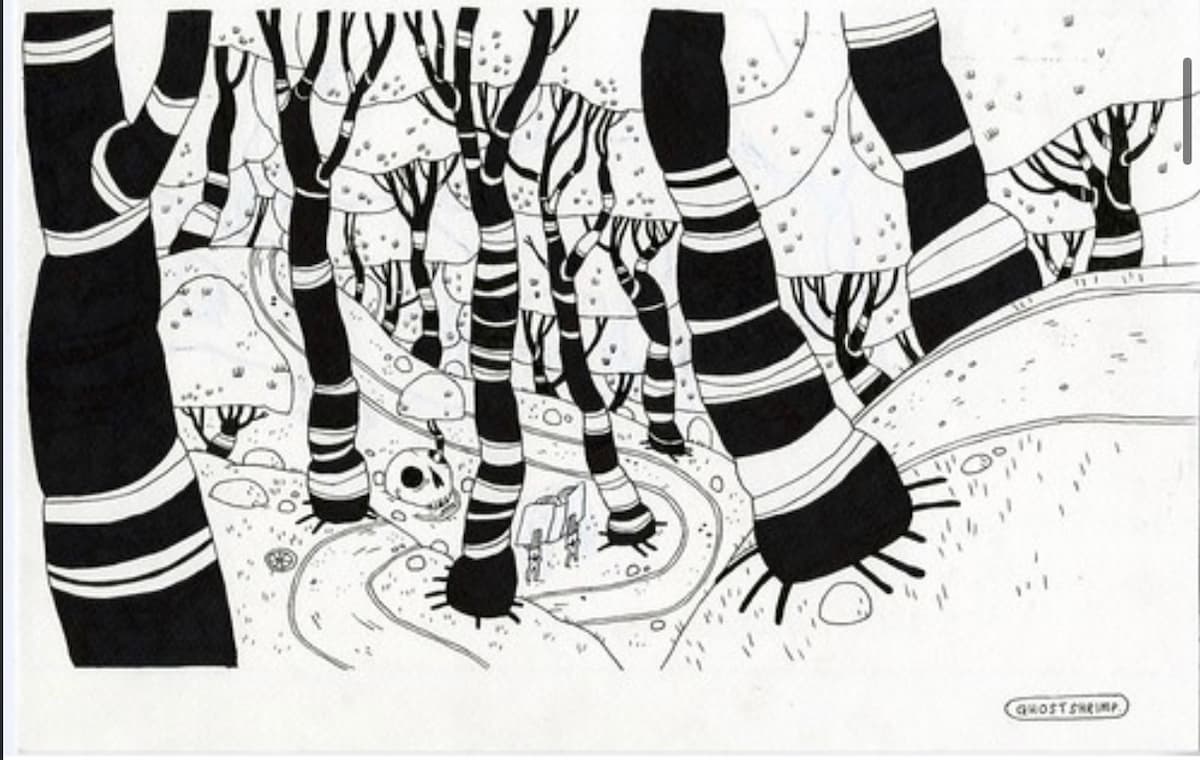
Even the background art of Adventure Time contains a lot of thought, intention and detail.
“I was scouring the web hardcore… I was clicking everything, trying to find artists who matched my sensibilities to some degree, or rather, trying to find an artist whose work appealed to me.”
– Pendleton Ward, Adventure Time: The Art of Ooo (2014)
According to Adventure Time: The Art of Ooo: “in contrast to many cartoon series’ backgrounds, which recede behind the characters in a generic fashion, Adventure Time’s backgrounds are snapshots of a living, breathing world that are as essential to the show as any of its characters.”
“[Background Designer] Ghostshrimp [Dan James] became available, and we all realized his style was pretty much perfect. It was a balance of graphic design simplicity, but with a really epic feel to it – so we could tell bigger, more adventure-y stories too”
– Patrick McHale, Adventure Time: The Art of Ooo (2014)
“I think that’s what’s cool about this show, because it allows people creative freedom and space to be themselves and to do their best work – something I didn’t think could exist in a TV cartoon.”
— Storyboard artist Seo Kim, Adventure Time: The Art of Ooo (2014)
“I’ll never forget that moment where Pen told me, ‘I want Adventure Time to take place in a Ghostshrimp world.”
— Ghost Shrimp, in a 2018 podcast quoted in Exploring the Land of Ooo: An Unofficial Overview and Production History of Cartoon Network’s Adventure Time (2023)
After Ghostshrimp signed on to work on Adventure Time, “Ward gave him relative free rein to design the universe as he saw fit.”
As Paul A. Thomas explains in Exploring the Land of Ooo: “Ghostshrimp’s backgrounds are off-kilter in a delightfully kooky way. Always looking to hide a joke or a piece of lore in even the simplest of backgrounds, Ghostshrimp often added strange bits of detritus–such as busted cars, oddly placed skeletons, wrecked spaceships, and deteriorating fantasy ruins–into his pieces; these hidden artifacts quickly became a defining feature of the show, and they played a key role in turning Ooo into less of a generic fantasy land and more of a postapocalyptic ruinscape.”
For the storyboarding team, Pendleton “sought out young illustrators, experimental comic book writers, or underground illustrators whose art he found entertaining.”
“”Pen was looking for artists who were not bound by the rules of animation.”
– Art Director Sandra Lee, Exploring the Land of Ooo (2023)
This brought a slew of talented and experienced artists, including Luther McLaurin, Armen Mirzaian, and Sean Jimenez; as well as some fresh CalArts graduates, including Niki Yang, Elizabeth Ito, and Cole Sanchez.
Yang would leave her role as a storyboard artist at the end of season one, but she remained a creative force on the series, voicing two characters, BMO and Lady Rainicorn, for the rest of the series.
“Season 1 was relatively easy for me, and really fun, but I think for people higher up it was incredibly stressful. I understand that a lot better now that I’ve run my own show. Probably the biggest worry I had was that I wasn’t going to deliver the kind of boards that Pen, Pat, and Adam had hoped for from me.
Really quickly I felt like I could pitch them my silliest ideas, and they would appreciate it. It was a really fun experience being storyboard partners with Adam. We were both really awkward at first, I think because we’re pretty introverted, and at least from my side of things, I was nervous that Adam was going to hate my jokes and drawings. I think I got past that pretty quick.”
– Storyboard artist Elizabeth Ito, Exploring the Land of Ooo (2023)
Storyboard artists often worked “in teams of two” but the artists tackled work duties in the way that made sense to them.
Storyboarding often took “about five weeks.”
According to Paul A. Thomas: “Sometimes, the pairs would actively work with one another, coordinating their efforts so that their portions of an episode would fit together seamlessly. Other partners preferred to work in isolation, consulting each other only when necessary.”
“Different boarders do it different ways. For me it’s always: how many pages I need to draw divided by how many days I have in which to do it, then hit those quotas as best I can. I’ve had partners who do one big quick take on the whole thing, and then do pass after pass refining things, but I need my schedule more concrete–it feels like less variables to worry about.”
– Tom Herpich, Exploring the Land of Ooo (2023)
“I think maybe the biggest strength of Adventure Time, the number-one secret of its success, is how simple it was when it began the structure was so flexible that the little seedling Adventure Time started out as could grow in any direction given enough fuel via the tender, moving care of the people work on it.”
— Thomas Herphich, Adventure Time: The Art of Ooo (2014)
Usually the first week contained the most work on dialogue, with less focus placed on drawings and animation. According to Paul A. Thomas, it wasn’t uncommon for the rough and early storyboards to be “on Post-It Notes or on plain pieces of paper.”
The next two weeks placed emphasis on implementing feedback received on the first week of work, as well as adding more dialogue and animation details.
According to Paul A. Thomas, this “inevitably resulted in dialogue being tinkered with, new jokes being added, and substandard gags being excised or tweaked until deemed satisfactory.”
During weeks three, four, and five, storyboards were “devoted to clean-up.”
Then more granular details are decided, like camera angles, and how finished, final poses look in shots.
Then it would go off to Cartoon Network for final approval, before a final revisionist made final tweaks.
According to many artists involved, the Storyboarding process “was often an emotionally mentally exhausting operation.”
“I was working 12-14 hours a day every day of the week … And I’d be working weekends … I really wanted to do a good job on my boards … Some artists’ storyboards are super rough and quick and it’s all like, short hand, and that’s a skill.” Castura told me something similar: “For me it was psychologically brutal, physically exhausting (so much sitting and drawing, so many all-nighters) and emotionally impactful on my personal life.”
– Andy Ristaino, in a podcast interview quoted in Exploring the Land of Ooo (2023)
“I struggled with the workload each time,” “Drawing 200+ panels 2 or 3 times in 5 weeks is a lot, even when it’s your full time job.”
– Storyboard artist and writer, Laura Knetzger, Exploring the Land of Ooo (2023)
“It’s hard to figure out a good workflow for something that’s so large. You have to produce just a ton of drawings for storyboards and it can be really daunting at first.”
– Storyboard artist Kris Mukai, Exploring the Land of Ooo (2023)
“Sticky notes are kind of translucent, so if you’re drawing multiple poses you can stick a post-it over one drama to trace, and then transfer it over to the next panel. Also because sticky notes are so disposable, it makes you feel a lot less precious with the drawings.”
– Storyboard artist Kris Mukai, Exploring the Land of Ooo (2023)
Then after the revisionists “polish” up the storyboard, the episode moved to the recording phase, where voice actors would add their character’s dialogue. Adventure Time differed from many other animated series in having all of the actors recording their lines in one room together. This added to the liveliness of the characters and dialogue.
According to Paul A. Thomas, “recording sessions usually took about three hours, and were held every week.”
Once takes were completed, an editor used editing software to time out the dialogue across the “polished storyboard panels.”
The episode would then have its timing cut and tweaked until it was the correct length.
Next the episode required a sheet timer, who would cut to the precise second, “down to the individual frame.”
This didn’t just include dialogue; everything that needed to be animated required timing, including mouth movements, walking, and sound effects.
Once the animatic timing was completed, “production moved into the design phase, which required extensive coordination.”
“Once a week, I would meet with the other department heads to break down a completed storyboard and see what needed to be designed for that particular episode. Then the rest of the week was the actual task of designing and drawing.”
— lead character and prop designer Derek Kirk Kim, Exploring the Land of Ooo (2023)
According to Paul A. Thomas, much of Adventure Time’s “look,” “with the characters’ noodly limbs and minimalistic faces” are inspired by the “rubber hose” animation “popularized by Max Fleisher in the early twentieth century.”
Paul A. Thomas writes about “the groundwork for this throwback style was laid by Ward early on, [but] it was formalized largely by character designers Phil Dynda, Tom Herpich, and Natasha Allergi during the production of Season one.”
All subsequent seasons followed these original character animations and designs, though Ward and Muto “often encouraged the artists to go off-model if it made a scene funnier or helped sell a certain emotion.”
Character clean-up artists take the in-progress episode next, polishing model sheets up “in Adobe Illustrator, using specialized brushes.”
According to Paul A. Thomas, “these drawings would serve as key visual aids, providing the animation studios with a clear understanding of how the characters or props were to look in a finished episode.”
Once all these steps were completed, the episode would be sent “to the South Korea animation studios SAEROM and Rough Draft Studios.”
According to Paul A. Thomas, ” the two studios often animated episodes simultaneously to speed up production.”
“The writers and artists try to write honest meditations about spiritual, magical, and mystical themes into episodes while keeping it funny and light enough to balance the heaviness.”
— Adventure Time: The Art of Ooo (2014)
Adventure Time was animated by hand, unlike many of its contemporaries, which took a lot of work, but gave the series a unique and special look.
According to Paul A. Thomas: “animators [first] penciled each frame onto paper. These pages were then scanned and loaded onto a computer, whereupon a dedicated team of artists used Toon Boom Harmony to digitally ink, color, and composite the frames.”
Once the animation process is all finished, the episode is sent back to be inspected for any issues.
According to Sandra Le in Exploring the Land of Ooo: “there were two common types of mistakes caught at this stage: “technicals” and “creatives”.
The former included small mistakes made by the animation studio; the latter “included instances in which the producers decided to make an aesthetic change to the final cut.”
Then finally, the original soundtrack would be added to the episode, making it all ready for air, after “about nine months of work to complete.”
Adventure Time was unique with its initial success as well, with executive producer Fred Seibert posting concept art and visuals from the yet-to-be-released show, a tradition that would continue for subsequent seasons from how successful it was at promoting the series.
“I have always been insistent that we share as much pre-production material as possible, even more than my own team was sometimes comfortable with. I thought the amount of people following closely were ultimately a drop in the bucket but that they were the most loyal, loudest people in the marketplace. Given the traditional bungling of marketing by most networks, and the unique nature of virtually everything about Adventure Time, it could only help us start up the fandom. We blogged regularly about Adventure Time in the years before we even had a series deal (this time on Tumblr). In time we had thousands of fans, just from the original 6-minute short, and hundreds of pieces of fan art.”
– Executive Producer Fred Seibert, Exploring the Land of Ooo (2023)
According to Paul A. Thomas: “The lawyers and PR personnel at Cartoon Network–constantly on the lookout for any perceived “misuses” of the network’s IP–often butted heads with Seibert over his decision to share production materials online, but in the end, Seibert’s methods played a key role in drumming up interest. With every new post that Frederator made on its blog about the upcoming series, it seems that the fanbase only grew larger.”
Adventure Time made its official debut in April 2010.
Many TV critics “wrote positively of the launch,” with many praising its fantasy setting and quirky humor.
“I remember watching the premiere together with the crew and executives… The part that I enjoyed the most was going online afterwards, scouring the internet for reviews, and checking out the funny fan drawings that slowly rolled in.”
— Pendleton Ward, Adventure Time: The Art of Ooo (2014)
By the next morning, on April 6, Cartoon Network renewed Adventure Time for a second season, with the network quite pleased that the premiere had been watched “by 2.5 million viewers.”
“Adventure Time the concept has become more than a cartoon: it has become a conduit through which creative people express themselves and a scaffold upon which they build, both in the studio and in the living rooms of fans everywhere”
– Adventure Time: The Art of Ooo (2014)
“… They said it was a weird little show, it wouldn’t work. It was odd. They had never seen anything like it before. And I couldn’t be prouder. We jumped on it, we stayed with it, and we powered through it. Lots of difficulties along the way. But to see it succeed us like, ‘Yeah, that’s a beautiful thing.’”
— Rob Sorcher, Adventure Time: The Art of Ooo (2014)