
André 3000, Big Boi, and OutKast | Prophetic Rap Music from the Dirty South

GIRL MUSIC is independent music journalism for anyone that loves pretty art and music.
» Consider buying me breakfast or coffee on Ko-Fi/PayPal, or leaving me a small tip on Venmo.
« Contact me at juno.stump@gmail.com if you need someone with experience in mock reviews, copy editing/writing, PR work, etc »
Words and research: Juno Rylee Schultz (she/her)
Research: Kylie Tuinier (she/her)
Edits by: Bex Stump (she/her) and Nathan Miller (he/him)
OutKast laid out visions of a futuristic utopia for Black America through the tapestry and language available within hip-hop music. André 3000 and Big Boi would expand on conversations happening within the lyricism of rap music, which was centered around surviving violence–heard inside the verses and choruses of The Notorious B.I.G. and Tupac Shakur.
It was 1995, and André 3000 and Big Boi’s debut album–Southernplayalisticadillacmuzik–had earned OutKast a nomination for Best New Rap Group or Duo at the Source Awards, an annual and prestigious award show in New York. This was before the Internet made it easier for artists to connect directly with audiences. The Source Magazine could put someone on, and help give an artist a career, so it was important, but there was also a lot of tension.
The 1995 Source Awards remains among the most important moments in hip-hop’s formation and history. This was near the peak of the rivalry between Death Row Records–from the West Coast–and New York City’s Bad Boy Records. The South wasn’t even on anyone’s mind at the time, and so it was almost a given when OutKast won Best New Rap Group over New York’s Smif-N-Wessun, and booing immediately started.
The strengths of André 3000 and Big Boi were successfully put to the test during the acceptance speech, with Big Boi demonstrating some Southern hospitality by thanking New York for having OutKast. To soften the anger in the room, New York was credited as the “Original emcees.”
Since Big Boi already paid respects on behalf of OutKast, André 3000 was able to use the smooth runway from his partner to unleash indignation. His frustration wasn’t just from feeling like OutKast and the South had a right to be there in the room, but even more so from a lack of being considered without having even been heard before.
André Benjamin’s words were heard throughout the entire rap community; even Tupac was watching from jail. It was a rallying cry, for the south to be allowed to have a say, too … to be allowed in the room.
“But it’s like this though: I’m tired of folks … them closed-minded folks.
It’s like we got a demo tape and don’t nobody wanna hear it.
But it’s like this: the South got somethin’ to say. That’s all I got to say.”
– André 3000 onstage at the 1995 Source Awards, through booing, after OutKast won Best New Rap Group
This was the beginning of the Dirty South, OutKast establishing its own identity, and a wider and more normalized lane for exploring deeper issues in lyricism, Afrofuturism, and less distance between funk inside of the hip-hop genre, still new and growing in its infancy and early days.
“It’s all day long, OutKast for life. Can’t nobody fuck with us.”
– Big Boi, 2011
The origins of hip-hop can be traced back to the Reconstruction Era.
When Emancipation came to America, it didn’t bring freedom and safety everywhere.
In fact, if anything, it brought more terror, especially in the South.
Racism didn’t go away with changes in laws, and the racists who felt their power was being taken away responded with violence. The Jim Crow laws made it easier for white southerners, while spreading the de-humanization of slavery and racism into different laws and packaging.
Racist, white southerners were provided an outlet for the anxieties they were experiencing, which is reflected in the music that was popular during the Reconstruction Era: Minstrel songs that were filled with joy about a happy and prosperous South.
According to An OutKast Reader: Essays on Race, Gender, and the Postmodern South (Music of the American South):
“The most popular music during the Reconstruction Era [were] wistful tunes … ballads and up-tempo songs about the halcyon days of the pastoral South. Many of the songs, such as “Old Dan Tucker,” “Darkies,” and others, highlighted racist characterizations of African Americans and benevolent views of enslavers.”
Fredara Mareva Hadley continues, in her essay titled ‘Power Music Electric Revival: Contemplating OutKast’s Southern Reconstruction and Its Impact on Black Music and the American Pop Mainstream’:
“African Americans participated in the genre as one of their few points of entry into the entertainment business, yet they also were exploring new ways to articulate their own life experiences.
In 1861, the famed Fisk Jubilee Singers were founded at the HBCU Fisk Institute and would pioneer a new genre of music that reimagined the folk Negro spirituals of the plantation by setting them to Western choral structure, harmonies, and tenets. Although, as anthropologist Zora Neale Hurston asserts, these new arranged spirituals were not the same melodies or contexts in which the enslaved created them, the written and adapted Negro spiritual enshrined the voice and humanity of the enslaved in ways that would preserve the truth of the South for generations to come.
Arranged spirituals were a Black musical innovation that newly emancipated Black students performed to create a bridge from the enslaved experience of their family into a world in which meager, yet sorely needed, educational opportunities were possible. Their creativity and pronouncement of self through music existed in direct contrast to the minstrel songs of the same century that formed the radicalized foundation of the American popular music canon.
Despite the end of chattel slavery, the unrelenting threat of violence met African Americans as they strove to assert their freedom. One of the most terrifying aspects of construction was the “night riders.” In her work, noted folklorist Gladys-Marie Fry relies on the Black oral tradition to describe how the Ku Klux Klan would ride into Black communities, sometimes wearing sheets, to intimidate and terrorize African Americans: “At other times Klan members murmured, “Ku Klux Klan, Ku Klux Klan” in a fine soft voice while performing their antics. Special effects designed to support the belief that Klansmen were confederate dead soldiers returned from hell.”
This deep division in the American populace prevailed and resulted directly from an insufficient answer to the question: how do we as Americans, Black and white, reconcile ourselves as a country? Second, how do we, as reconciled Americans, forgive treasonous white southerners who had the gall to secede from the United States of America? Actually, and in hindsight, answering these two questions must precede and stimulate progress in answering the “Negro question.” is a matter of American folks over American finances.
Under the weight of these heady questions and racial oppression, late nineteenth-and early twentieth-century Black southern musical innovation thrives. Black musicians in the red-light Storyville district of New Orleans combined syncopation, collective improvisation, and expansive harmonic ideas to create jazz. In the Delta, rural juke joints and sharecropping fields incubated the Blues. In the Piedmont region of North Carolina and Virginia, Black banjo players and guitarists practiced a style of dance music that brought African instrumental ingenuity to America. These Black southern musical innovations stood as a testament to the humanity, resilience, and creativity that soundtracked the lives of African Americans and led to genres–jazz, rock and roll, and country–that would shape the American popular music mainstream.
Music moved around with people and in the 1930s and 1940s, African American migrants carried their music with them such that the rural Delta blues became the Chicago Urban Blues and New Orleans Jazz made a home in Harlem as swing. Black southern styles made northern adjustments to reflect a more complicated and cacophonous existence.
In reality, urban Black life was not the utopia many had hoped, and by the 1970s deindustrialization, disinvestment in city centers, and the rising impact of illicit drugs gutted dreams of sustained urban prosperity, leading to the creation of hip-hop in the Bronx in the late 1980s, its eventual move to Los Angeles in the 1980s, and its own bloody civil war between those two coasts in the mid-1990s. The violence culminated with the murders of Christopher “Notorious B.I.G.” Wallace and Tupac Amaru Shakur.”
It is here where we can clearly trace the lines between emancipation, the Reconstruction Era, jazz and blues, the need to contend with living under a threat of terror and violence, and not feeling at home in a place you live.
It is here we can also see how directly tapped in and connected André 3000 and Big Boi are to the origins of hip-hop, and tragically, in many ways, the beginnings of several genres of Black music, by communicating they are survivors of racial terror, just like any living Black person who is aware of the still-present threat.
As Michelle S. Hite explains in her essay, Andre’s Dead: Communicating Survival of Racial Terror, civil rights activist James Baldwin and Andre Benjamin are both critical of a society that has traumatized them with racial violence across history, while also feeling surprised at the fact that they survived.
James Baldwin and André 3000 were both traumatized by the Atlanta Youth Murders, both recognizing the random violence that was racially motivated, and how it motivated them both to speak about what scholar Cathy Caruth terms “the enigma of survival.”
James Baldwin starts ‘The Evidence of Things Not Seen’ with a preface that explains he is a Black American living in France because he “recalls his homeland as a site of terror.”
Baldwin later continues this thought in ‘The Evidence of Things Not Seen’, writing: “I have never, in all my journeys, felt more of an interloper, a stranger, than I felt in Atlanta.”

André 3000 and Big Boi both recall Atlanta, America, and the world as a place of terror, even claiming to be “ATLiens” and not part of this world as a result: a world with hope that’s different from here, without ignoring what brought us here.
“Like starting out, ground zero at the dungeon, we lived at the studio. we woke up on the floor, got up, went downstairs, maybe not even brushed your teeth yet, and started rapping.”
– André 3000, 2023 (CBS)
Southernplayalisticadillacmuzik quickly sold over a million albums, putting hip-hop from the South on in a big way, for anyone who hadn’t heard André at the ’95 Source Awards. Equally importantly, since Arrested Development was from the South too, OutKast painted an urban picture of the South, with city blocks and streets. This gave reason for people in hip-hop, and anyone not from the South, to see the South as a place where music and things can be made, and less like a site of terror with fields.
As Regina N. Bradley explains in the introduction to An OutKast Reader: Essays on Race, Gender, and the Postmodern South (Music of the American South):
“OutKast’s iconic blend of funk, gospel, and blues, spearheaded by their Atlanta-based production team, Organized Noize, created a distinctive southern hip-hop sound that allowed them to tell stories that were equally distinctive and southern because of their Atlanta roots. Additionally, OutKast’s first album, Southernplayalisticadillacmuzik introduced the possibility of an urban space in the Deep South, a believed cultural anomaly because of the South’s reputation as an agrarian and dominantly rural space.
As Imani Perry argues in Prophets of the Hood, ‘OutKast alerts us to their southern frame of reference with food, style, and dialect. It is the contemporary urban South that animated their first several albums, that unique meeting of the traditional, the old and the new, plus the ‘same old, same old.’
Perry’s rendering of the contemporary urban South as an intersection of past and present can be read alongside Zandria Robinson’s theorization of what she suggests as country cosmopolitanism, ‘a best-of-both-worlds blackness that addresses the embattled notion of racial authenticity in a post-black era by hearkening back to and modernizing rural, country tropes . . . . It blends rural values and urban sensibilities to navigate–and sometimes sanitize–the post-civil rights South.’
Read within Perry and Robinson’s frameworks, OutKast utilizes both their Atlanta roots and recognizable tropes of the South–slavery, rurality, and even the heralding of education–to establish themselves as not only hip-hop, but an act of defiance that runs parallel to the rhetoric of civil rights protest from the mid-twentieth century. Their subversion of the tropes and aspirations upheld by previous generations of Black southerners makes possible the complication of what is considered the modernization of the mineage of the South’s place in defining southern sociocultural and political movements in the twentieth century.”
Southernplayalisticadillacmuzik established the foundation, the space, the canvas, and from there, OutKast continued exploring the themes and places that had been opened up on their first album, their platinum certified album.
The two had already come a long way, for their age, and for having just gotten started.
André and Big Boi had only been featured on one released recording before the group’s debut: the rapping on TLC’s remix of ‘What About Your Friends’, which was at the recommendation of Organized Noize, who had caught the attention of LaFace Records, with their work in and around the hip-hop scene of Atlanta.
This all went so well, it led to an album being approved for Organized Noize, who, as a production team, just wanted to work with an artist that could respect vision and work collaboratively.
OutKast had been hanging around “the Dungeon”, the unfinished basement where Rico Wade operated a home, DIY, recording studio. This was where “the Dungeon family”, consisting of Organized Noize and all the artists and friends that hung around the studio. Its name in part came from the clay floors and walls that weren’t finished, but it was also because people would stay down there for days at a time working on music and production.
André and Big Boi–André Lauren Benjamin and Antwan André Patton–met in high school, and became friends right away. The two started rapping together at Big Boi’s Aunt’s house, trading back and forth every four bars, and immediately formed a band together.
“We had only one Korg mic, with a short ass cord, so we’d pass it back and forth, trying to catch each other’s word and pass the mic.”
– Big Boi (2004)
In 1992, André and Big Boi would meet Rico Wade, of Organized Noize, who was working a day job at Lamonte’s Beauty Supply. The fresh and clean duo walked into the store to speak with Rico Wade. Big Boi knew of Rico Wade through an ex-girlfriend, and while it wasn’t uncommon for aspiring rappers to want to speak with Wade.
Rico Wade felt there was something different about them.
Within a few minutes, André and Big Boi were rapping over an instrumental version of A Tribe Called Quest’s ‘Scenario.’ The two also did some freestyling to impress Rico Wade further. A few days later, OutKast was a regular part of the dungeon family, working on music still and with more resources–including other artists that could offer insights and critiques.
“From the first time Rico Wade pressed ‘play’ on the tape, we knew we had our producer because the beats were like nothing I had ever heard before.”
– Big Boi (2004)
“There’d be nine, ten guys and everyone would take turns rhyming over a beat. It would be your turn to rhyme, and you’d start, and then Rico’d be like, ‘Oh, did the pizza come yet?’ Break your fucking heart, man.”
– Big Boi (2004)
After LaFace Records continued working with Organized Noize after being happy with the results of the remixed TLC track, the label came back and asked for a song for A LaFace Family Christmas, the record label’s 1993 Christmas compilation.
Organized Noize naturally went back to OutKast. This would mark the duo’s first original track on an album, and this Christmas track–called ‘Player’s Ball’–was a subversion of Christmas themes, and perhaps everyone’s expectations, when the song started climbing multiple Billboard charts, including the Billboard Hot 100. This would be an impressive feat for any Christmas song, but it was also the first original track from OutKast to be released, making it even more of an occasion.
This would lead to Southernplayalisticadillacmuzik, OutKast’s record deal, and the beginning of the duo’s journey through the charts and industry.
“Southernplayalisticadillacmuzik was just a go-for-what-you-know-like-a-wild-thing, ‘this is our first chance, we’re just going to do it.’ so the second album was definitely more serious and more thought-provoking, like for cooling out and thinking”
– André 3000
Outkast’s second album would continue the group’s trend of highlighting the world around them, while also making the declaration that the two were aliens–or ATLiens–in their own city and homeland.
Miles Marshall Lewis put it so astutely in a 2014 piece for The Guardian, in his articulation of how it looked in 1996 when Atlanta hosted the Olympic games:
“The dichotomy of the south hosting the 1996 Olympic Games while 80 black churches have been burned to the ground in the past six years is ironic. In the least, Atlanta itself has always been concerned with promoting appearances that belie its inherent contradictions; a city with a two-thirds-black population (and three black mayors) that continues to fly a Confederate flag, for example.
The coming of the Olympic Games has produced dozens of homeless outcasts by the razing of inner-city areas like Techwood to make room for the Olympic village. The clearance of low-income housing areas has taken place to erect temporary sporting venues for the two-week long Olympic events.”
It was in the face of this Atlanta, that was crushing its homeless and working class people, that OutKast would release their prophetic warnings and musings on what needed to be done on their second album, ATLiens.
“Being an alien is just being yourself, when people don’t understand you. We just trying to let everybody know there’s a place for everybody in this world. You just gotta find yourself, and be true to yourself. That’s how you get prosperous and happy.”
– André 3000 (1996)
On ATLiens, André and Big Boi spoke about how life really was; for the average Black person in Atlanta, and down in the South, instead of the costume and prop version that was being held up by Atlanta during the Olympic games.
André and Big Boi brought in even more funk and brass into the production of this album. They even produced seven of the sixteen tracks on the album, as Earthtone III, the new production team the two had formed–a sign of how much they were learning and taking on regarding the artistic process.
During this time André stopped smoking and drinking, and Big Boi had his first child, Jordan, which he would end up raising as a single parent. The two men were going through a vast array of changes while still pushing forward healthily as people.
‘Elevators (Me and You)’, the first single from ATLiens, charted on the Billboard Hot Rap Singles chart, and the Hot R&B Singles chart, before breaking into the Billboard Top 40.
By November 1996, ATLiens had sold millions of copies and went platinum, just like their debut. André and Big Boi were both only 21 years of age, and it was clear the two had plenty more to say.
The same success would follow with OutKast’s Aquemini, when it was released in September 1998, with the album going multi-platinum within a few months, just as OutKast’s first two albums had.
Things would somehow be even bigger with the explosion of Stankonia, the band’s fourth album, when it came out on October 31, 2000.
“Whatever you say about us, our shit gonna be funk and the beat’s gonna be hard. I don’t give a fuck about anything after that.”
– Big Boi
Stankonia would be delayed a few times, but no one was really worried about it, least of all André 3000 and Big Boi, who had recently purchased their own studio in Atlanta. Paying for hours in the studio was a thing of the past, and the two were free to experiment as much as they wanted in Stankonia Studio.
Big Boi was in the studio while André was at home experimenting with new instruments. He and his partner Erykah Badu were also raising their son together while the duo wasn’t on tour.

Erykah Badu, an artist and musician herself, would go on to guest on two OutKast albums, as well as being a major source of inspiration for Stankonia’s lead single, ‘Ms. Jackson’, when the relationship between the two ended.
“‘Stankonia’ was a word we made up joking around. You know, if it’s stank, it’s good, it’s funky. ‘Stankonia’ is the place, the capital we want to bring listeners to.”
– André 3000
‘Ms. Jackson’ was a combination of a tape being played upside down in the studio–something that had happened by mistake–and André 3000’s poetic apology to Erykah Badu’s mother, for his relationship with her daughter ending, or rather, an attempt at making peace with it, and with her. It was André trying to make amends with mistakes while moving forward.
It was also André 3000 and Big Boi both collectively expressing the need for men to help women take care of the kids, no matter how things go. It was a statement of helping the family–your family–regardless of the mistakes you make.
The song was more than a touching and poetic moment in hip-hop and lyricism. By November 2000–a month after the album’s release–Stankonia would go multi-platinum, with ‘Ms. Jackson’ riding on multiple Billboard charts, including the Billboard Top 40. Within a few months, in early 2001, ‘Ms. Jackson’ was at the very top of the Top 40 chart, and Stankonia had gone triple-platinum.
“I never totally dedicated myself to anything. I’ve always been a jack-of-no-trades, but just making it happen: You know, play guitar just enough to play on The Love Below. Play piano just enough to do “Ms. Jackson.” My first chords were “Hey Ya!”
— André 3000, 2017 (GQ)
OutKast took home an MTV Video Music Award in September 2001 for Best Hip Hop Video for Ms. Jackson. In February 2002, the hip-hop duo won their first Grammy, Best Rap Performance by a Duo or Group, for ‘Ms. Jackson.’ André and Big Boi also won a second Grammy, Best Rap Album, for Stankonia.
The subversive packaging and messaging about the failures of the American dream were reaching more people than ever before. Touring was beginning to exhaust André 3000 around this time, as OutKast moved from clubs and small stages to packed arena tours.
A greatest hits compilation album–which Big Boi preferred to refer to as a “refresher course” for people who had just discovered OutKast from Stankonia–gave André and Big Boi even more creative freedom and even less pressure from the record label.
This gave them both time to rest and recover, but it also gave André 3000 plenty of time to get lost inside of The Love Below, his piece of OutKast’s final album together.
André 3000 and Big Boi were both closer than ever, personally and as friends, just as they had been since they met in high school, but the two were both wanting to explore different things musically. This included them both having a desire to release solo albums, but the record label, in the wake of several multi-platinum albums, and Grammy wins, didn’t want to sign off on that.
André and Big Boi found a creative solution: two solo albums, held up under the same OutKast crown, which could hold and express the full creative spectrum of the two artists.
Big Boi’s contribution, Speakerboxxx, would be an all-out, last call for OutKast, packed with features from the Dungeon Family and other friends, with nothing held back.
André’s contribution, The Love Below, was a huge departure from anything anyone was expecting, from André and OutKast–and it delayed the release of the album so many times that Big Boi started to get anxious and wanted to release Speakerboxxx solo.
It was February 2003 and Big Boi had been done for several weeks, but André was nowhere finished with The Love Below.
André was wrapped up in guitar jam sessions, piano melodies, and exploring the meaning of love, life, and how to express everything he was processing. Some of the songs he was working on for The Love Below were from a few years ago, including Hey Ya!, but others were from a soundtrack he was working on for a film that was canceled. Ideas were swirling and Andre was trying to tame them and his songs, but he kept missing deadlines.
“When I first got Andre’s whole record, I must have called him like five times [laughing]. ‘Hey, boy! you lost your mind on this one! I’m telling ya!”
– Big Boi, reflecting on hearing The Love Below (2004)
By August 2003, it was down to the final crunch and deadlines. If Speakerboxxx/The Love Below was going to be released that year, André had less than a month to get everything finished for his side of the double-album.
André was working across multiple studios by the final week of that month, even staying awake for four days straight, but he pulled it off.
The record label asked André 3000 and Big Boi to both choose a song for the singles for the album. Big Boi chose ‘The Way You Move’ and Andre chose ‘Hey Ya!’

Both songs went straight to the top of the Top 40, and remained there at the end of the year, and for months afterward. In the end, OutKast would spend three months at the top of the charts with their two lead singles.
By January 2004, Speakerboxxx/The Love Below would be certified eight times platinum. A month later, OutKast would be awarded three Grammy awards for Speakerboxxx/The Love Below, which included Album of the Year, a monument and testament to the risk and perseverance of OutKast, and proof that the South had something to say.
Big Boi remains active in creating hip-hop music that can be traced back to Organized Noize and the Dungeon Family, OutKast’s beginnings, including perhaps most notably with Sleepy Brown, in projects such as The Big Sleepover, as well as continuing the OutKast legacy.
“When I pass away, people will find hours and hours of files. hard drives and shit. It’s hard drives of me just in the house alone playing horrible guitar. Me playing piano. Me playing a little sax. I was trying to find out: What can I be excited about?”
– André 3000, 2017 (GQ)
In 2023, André 3000 released New Blue Sun, an album of atmospheric flute music, as the artist remains committed to exploring the world, art, and music, and himself as a human being. He has largely retired from rapping, outside of features he does occasionally for collaborators and friends, like Killer Mike, and for up-and-coming rappers, who have come after him–including Frank Ocean, Vince Staples, and Travi$ Scott–as André passes down the awareness of the horrors, the power of storytelling, and the possibilities of the future.
“I just feel like it’s an ongoing experiment with humans, and we learn every day what’s real and what’s not real. Or, what we thought was real is not necessarily that important. I won’t be around, but I can’t wait till a few hundred years from now and they look back at all the stuff that we were doing. It’s going to be something that we’re doing right now that they’re going to be laughing at. “Hold up, so they did what?” [Laughs.] And it’s something that we think is totally right.”
– André 3000, 2024 (Rolling Stone)
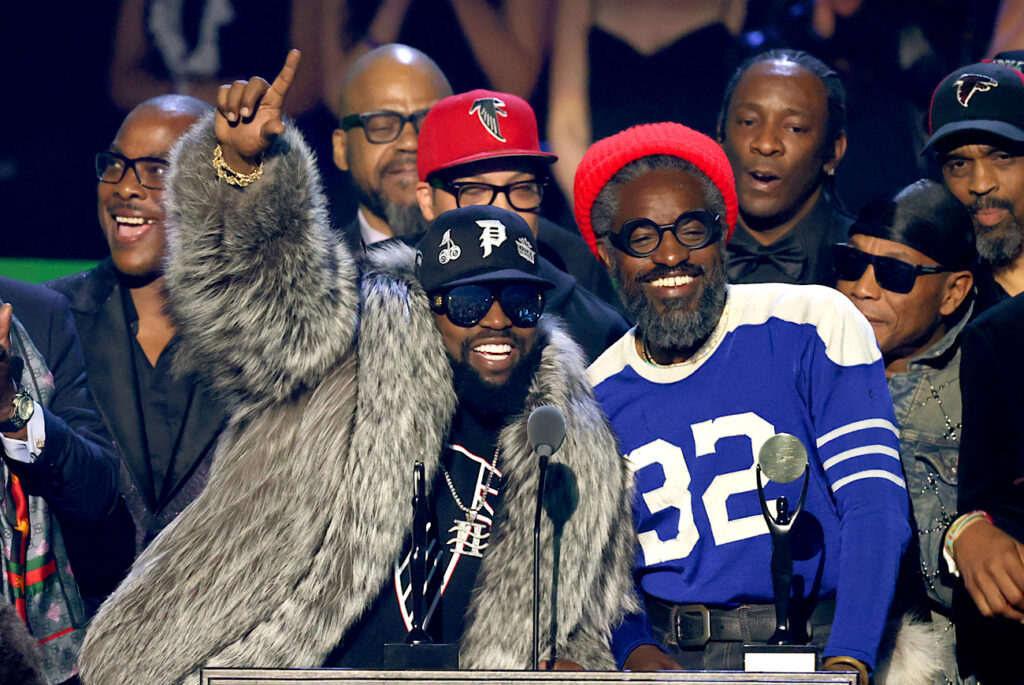
On November 8, 2025, OutKast was inducted into the Rock and Roll Hall of Fame, “for bringing their vision of the “Dirty South” to hip-hop” and for “significantly [broadening] the genre’s palette.”
The White Stripes were inducted during the same ceremony and the two groups shared a special moment; during André 3000’s portion of OutKast’s acceptance speech, he called out into the crowd to Jack White, of The White Stripes, saying “Man, he’s one of my favorites … Jack, where you at …”
When the Rock and Roll Hall of Fame ceremony cameras found Jack White’s face in the audience, André continued: “Man, we love you … you said something [in your acceptance speech earlier] about little rooms, and we started…”
Andre paused, before continuing, through tears:
“Great things start in little rooms.”
Tags: Afrofuturism, Andre 3000, Big Boi, Dungeon Family, Girl Music, Hip-Hop, outcast, OutKast, Rap Music, Rico Wade
One response to “André 3000, Big Boi, and OutKast | Prophetic Rap Music from the Dirty South”
-
You always dig deep into every detail of your subject. Damn fine work here, Juno. Your quoting and timeline research are superb.

Leave a Reply