
 Kylie Tuinier
“The devil has got hold of the food supply in this country.” – Algernon Paddock of Nebraska
ALL THIS HAPPENED, MORE OR LESS is independent political and history journalism for anyone interested in information about how reality got here without sponsors.
This piece was written entirely by Kylie Tuinier, my friend and assistant who works with me on journalism edits and research.
»Consider buying Kylie breakfast or coffee on Ko-Fi/PayPal, or leaving her a small tip on Venmo.
« Contact her at kptuinier@gmail.com if you need someone with experience in research, writing, editing, etc »
Words, research, and edits: Kylie Tuinier (she/her)
Research and edits: Juno Rylee Stump-Schultz (she/her)
Edits: Bex Stump (she/her) and Nathan Miller (he/him)
During the late nineteenth and early twentieth centuries, food safety became a serious concern in the United States. As industries grew and production increased, many manufacturers began using cheap, artificial chemical additives to make products last longer and boost profits.
Some companies also used misleading labels to hide the chemicals and additives in the food. At this time, the government had very few regulations to prevent these practices, leaving consumers unaware of the harm these foods could cause. Growing concerns, scientific research, and public pressure led to changes of the food safety laws.
Milk, a staple in the American diet, was diluted and treated with formaldehyde to extend shelf life. An 1850s newspaper revealed milk factories that were fly-ridden and maggot-infested, and the animals were being fed warm swill that still contained sugar and alcohol.
Pediatricians were encountering many health problems that were being linked to the milk, one doctor wrote, “I have every year grown more suspicious of distillery milk whenever I have seen a child presenting a sickly appearance, loose flabby flesh, weak joints, capricious appetite, frequent retching, and occasional vomitage, irregular bowels with tendency to diarrhea and fetid breath.”
New York City passed a regulation in 1862 outlawing swill milk, to little effect as swill milk was still being produced. Indiana’s state board of health found sticks, hairs, blood, and pus in the milk samples, and in New Jersey there were so many colonies of bacteria that they stopped counting. At the same time, butter and cheese were being made from diseased, parasite-ridden meat and processed animal fat. The Butter Act of 1886 was very ineffective. The law defined butter as “made exclusively from milk or cream”, so products like butterine had to be labeled “olemargerine”, and assuming they’d be caught, false labelers could be fined up to $1000.
In 1887, Bulletin no. 13 was published. Harvey Washington Wiley, an American chemist from Indiana, was head of the Agriculture Department at the time and had put a team of chemists together to do a detailed study of various food products. The report revealed that there was little change for how milk was produced.
It wasn’t just bacteria swimming in the milk, the chemists found a thinned product, dirty, and whitened chalk, and at least one sample had worms wriggling in the bottom of the bottle. Most of the butter found on the market had nothing to do with dairy and patent applications for margarine listed nitric acid, sulfate of lime, and sugar of lead as ingredients.
Bromo-chloralum, a disinfectant used in smallpox, was used to remove the smell and hide the evidence of ground-up cow, sheep, and pig stomachs. Health concerns revolved around the dyes used in butter and margarine the most. Suppliers were adulterating the dyes with brick dust, chalk, lead, and red ocher. Bulletin no. 13 also focused on another concern: “Fermented Alcoholic Beverages, Malt Liquors, Wine, and Cider.”
Its main focus was the use of salicylic acid, a preservative added in large amounts to increase the shelf life of the product, and its use was increasing. The chemicals used in the alcoholic beverages could add up to a harmful dose considering many of the population would have multiple beverages a day. Seventy American wines were tested, more than one-fourth contained salicylic acid, and same for the beers and ales tested.
Coffee, a beverage loved by the American public, was heavily altered. Wiley’s staff had discovered 87 percent of all coffee ground samples were adulterated by 1892.
“One sample contained no coffee at all.”
Processors had even found a way to make coffee-free “beans,” using flour, molasses, dirt, and sawdust, pressing it into a mold. The average scoop of coffee beans had about 25 percent of the artificial additives. They also took to the practice of coloring inexpensive coffee beans and selling them as Java beans for a higher price. These coffee coloring agents were made up of charcoal and finely powdered iron.
While Wiley and his chemists were fighting for food safety, many manufacturers and even politicians were giving a lot of pushback. The governor of Nebraska, Julius Morton, had claimed the Agriculture Department had been “well on the way to becoming a national feed bag.” After a month in office he had called Wiley in and told him the department would only focus on science that would directly benefit farmers. Bulletin no. 13 had an examination of canned vegetables still in progress, Morton told Wiley that it would be the last, he insisted that the Agriculture Department’s goals did not include educating the public.
Congress revisited the quality of alcoholic beverages in 1896, with whiskey being the most looked at. Because of a prior law, distillers had a period between producing the products and having to pay taxes. It was an incentive to keep liquor in barrels resulting in a better-quality aged whiskey, but some distillers diluted the liquid with ethyl alcohol, tinted it brown with tobacco extracts, and labeled and sold it as the higher-end aged whiskey. After much complaining, Congress passed the Bottled-in-Bond Act in 1897, the act stated that each bottle that was aged for at least four years would get a green “bonded” seal.
It wasn’t only the public suffering from the poor food quality; the “embalmed beef” scandal affected American soldiers in Cuba when the war ended in August. Major General Nelson Miles asked for an investigation after receiving reports of a chemical smell coming from the beef, cans swarming with maggots, and some cans containing a mix of meat and charred rope. One army doctor claimed that many of the cans were “apparently preserved by injected chemicals to aid deficient refrigeration,” smelling of formaldehyde and tasting like chemicals.
This opened up, what the newspapers called it, the “Beef Court” in March 1899. It was revealed that the beef had been poorly handled, stringy, and quick to decompose, but it was not being adulterated with formaldehyde, instead meatpackers were using table salt as it was far more inexpensive, mixing it with saltpeter which is also an ingredient of gunpowder. Rather than using costly preservatives, packers hadn’t used enough salts to prevent decomposition in the Cuban heat. The companies defended their products stating they had not had any bad meat returned to them, which was true, but that was because the military destroyed the bad meat. The Beef Court concluded in scolding everyone involved for creating a problem and did not hold the meatpackers accountable.
In June of that year Cincinnati’s public health chemist had found Freezine and Perservaline, both containing formaldehyde and Freezine’s slogan was, “Meat can be exposed for sale, returned to ice, more of the preparation applied, and still look good to the eye.”. The chemist was originally looking for salicylic acid after “an epidemic of stomach trouble, due particularly entirely to involve beef.”
Officials recommended citizens to avoid beef entirely. That same month Nebraska’s health department had warned all families against the use of milk and creams produced by local dairies. Many children were dying as a result of this “embalmed milk” and they found the problem was preservaline. Almost immediately after Nebraska’s scandal, Indiana had problems with Dairies in Indianapolis. The issue wasn’t Preservaline this time, it was formaldehyde. Dairies were pouring the formaldehyde into milk, masking its rotting appearance and taste, leading to more child deaths.
In the spring of 1899, a new set of hearings on concerns for the country’s food and drink supply, The Mason Hearings, began and continued for almost a year.
The Chemistry Division was set to analyze hundreds of samples and found that for almost every food product they could point to a trick involved in manufacturing.
Insects were ground up and passed off as brown sugar and sometimes live lice would survive the process.
Wiley testified that 5 percent of all foods and 90 percent of coffees and spices were adulterated. He also concentrated on the preservatives in dyes, citing the practice of coloring canned peas with copper sulfate and zinc salts. But he didn’t recommend an immediate ban, he insisted regulations should follow good science and urged the government to invest in researching the side effects of the additives.
“This is the only civilized country in the world that does not protect the consumer of food products against the adulteration of manufacturers.”
– Senator William Mason of Illinois.
Using the slogan “Commercial well-being and good understanding among the American Republics.”, the Pan-American Exposition opened in Buffalo in May, 1901. Wiley and his team presented a display organized by Willard Bigelow called “Pure and Adulterated Foods.”
The display put the rising use of industrial preservatives front and center, it showed examples of the coal-tar agents used in coloring food and drinks, and the display included various examples of fake products ranging from vinegar to whiskey, showing a new practice of adding soap to alcohol to simulate the way aged bourbon would look. By this time the Bureau of Chemistry had found 152 “new” patent preservatives on the market, the term “new” was used loosely though, as many of the products were remixes of old additives like formaldehyde and copper sulfate.
Edwin Ladd, an analytic chemist in North Dakota, launched a state-wide campaign for a pure-food law stating “More than ninety percent of local meat markets in the state were using chemical preservatives and in nearly every butcher shop could be found a bottle of Freezine, Preservaline, or Iceine. In the dried beef, in the smoked meats, in the canned bacon, and in the canned chipped beef, boracic acid or borates are a common ingredient. Ninety percent of the so-called French peas we have taken up in North Dakota were found to contain copper salts.”
Edwin Ladd reported that in almost every food product he found unlabeled industrial additives that had not been tested for safety, and some were known toxins.
Wiley had asked congress to fund a “hygienic table trials” in 1901 and began the trials in 1902. He wanted to use human guinea pigs, sit them down in a clean and carefully controlled setting, and feed them meals that were meticulously measured and monitored. One half of the volunteers would get clean, additive free food, while the other half would get a specific dose of a preservative in each meal. Him and his staff would monitor health effects carefully and the volunteers could not know who was eating what.
The Bureau of Chemistry put out an advertisement to recruit people for the trials, Wiley wanted “young, robust fellows, with maximum resistance to deleterious effects of adulterated foods,” the idea was “if they should show signs of injury after they were fed such substances for a period of time, the deduction would naturally follow that children and older persons, more susceptible than they, would be greater sufferers from similar causes.”
The experiments focused on borax first, one of the most widely used preservatives, but concluded it was relatively benign, it did cause some temporary nausea and diarrhea but decided that “neither boric acid nor borax in any way affected the health and well-being” of the volunteers.
But by the summer of 1903 as Wiley was continuing the research on borax he found it was not as benign as he had assumed. He filed a report concluding that it wasn’t the dose that was necessarily toxic, but the everyday exposure, “the experience of the previous series having shown that the administration of increasing doses of borax produced feelings of distress in both the stomachs and the head.”. At the same time the borax report was being published they were testing the next additive, salicylic acid, and the volunteers were experiencing worse symptoms and already showing signs of nausea and dizziness.
Congress was now weighing the idea of basic protective rules once again. Meatpackers, manufacturers, dairy companies, bakeries, chemical companies, and liquor distributors opposed the proposed legislation because they were worried it would affect their profits.
Whiskey distributors didn’t want to reveal some of the actual ingredients so they fought against the labeling requirements.
The processed food industry had formed its own organization, the National Food Manufacturers Association, and they were seeking a “proper” law that would allow them to get around Wiley and his recommendations. They paid different chemists to try to disprove that the additives they were using were toxic and wanted to argue that the chemicals were safe and beneficial. Wiley realized he was looking at another failed legislation, he needed help beyond lawmakers and science. He asked for the help of the Woman’s Christian Temperance Union (WCTU) on raising awareness about the dangers, which had already been pressuring Coca-Cola to reduce cocaine levels in the formula since 1902.
In 1904, St. Louis opened another world’s fair with food as the main subject. The states that participated brought in forty brands of ketchup that were mostly stewed pumpkin rind dyed red, and fifty brands of baking powder that had well-ground chalk and aluminum compounds. They showed that every food still contained large amounts of adulterants, “Down a long list we might go, telling the secrets of those who are putting dollars into their pockets by putting poisons into our foods,” butter still mislabeled as olemargarine, spices were just ground nut shells, and maple syrup was just glucose dyed brown.
Idaho’s senator, Weldon Heyburn, had a food and drug bill called up before the Senate by 1905. The National Food Manufacturers Association wanted Heyburn to back a different bill, one that allowed the use of preservatives and left the authority of food and drink to the business friendly Department of Commerce and Labor rather than the agriculture department.
“Labeling Ruinous to Liquor Trade” headlined the New York Journal, liquor distributors declared that this new bill would damage businessmen and government income and taxes would suffer. They insisted on removing any whiskey-labeling requirements from the bill. As predicted, the bill failed in both houses within a few months.
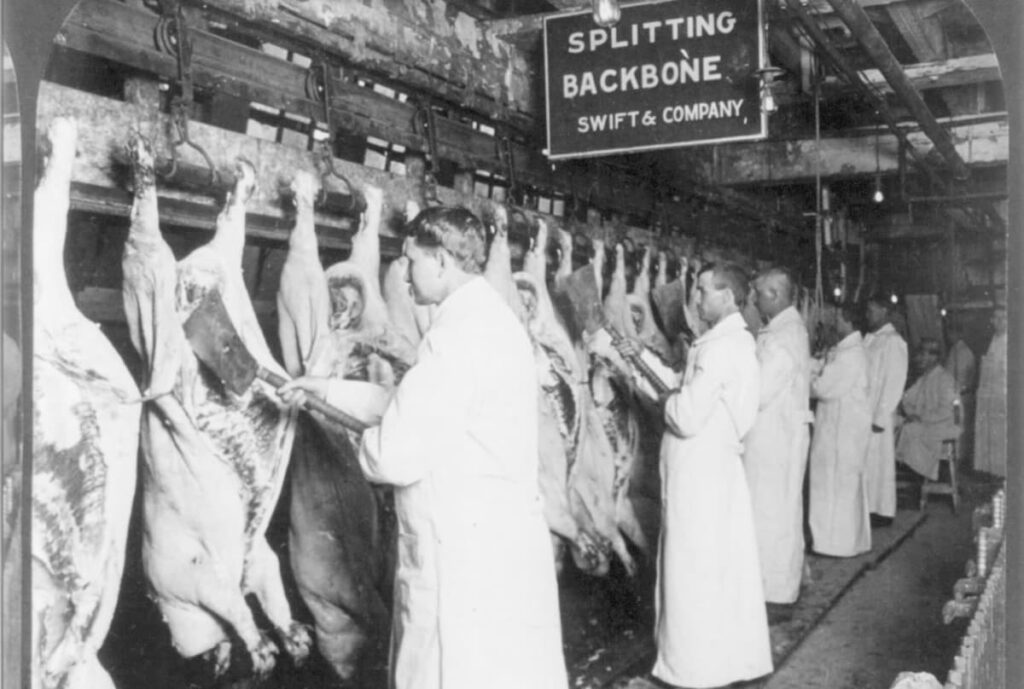
Upton Sinclair wrote a novel titled “The Jungle”, it described diseased cattle being brought by railroad over to Chicago, pickled beef would be bathed in acid, and tuberculosis germs lived in the moist, stinking air that spread animal to animal.
There were open vats of acid that workers would occasionally fall into and rotting meat, even when fuzzed over with mold, would be cleaned, “dosed with borax and glycerin and dumped into hoppers and made over again for home consumption.”
The packers would put out poisoned bread to keep the rat population down, and then “the rats, bread and meat would go into the hoppers together.”
“The Truth About Food Adulteration,” written by Henry Irving Dodge, continued to expose manufacturers and criticize the dangers of contaminated milk. Ranging from Brooklyn to Chicago, authorities condemned almost five hundred vats of milk in a week. In New Jersey a doctor had blamed an increase in child deaths on the use of formaldehyde, and in New York unpasteurized supplies had caused another outbreak of typhoid.
More than twenty thousand children under the age of two had died by 1904 in New York City and the milk was a big factor.
Paul Pierce, an advocate for safe foods and publisher of What to Eat magazine, put out a series called “The Slaughter of Americans” in 1905.
“In view of the widespread adulteration of foods in America, that is adding greatly to the death roll and causing more sickness and misery than all other sources combined, What to Eat has decided to publish a series of carefully compiled articles revealing to Americans the actual condition of the food we eat today,” he wrote and assured readers that butter now contained enough coal-tar dye to kill a cat and cited in another article that 400,000 infants died due to poor food and formaldehyde in milk every year.
President Roosevelt announced on December 5th, 1905, that he was backing the legislation, “I recommend that a law be enacted to regulate interstate commerce in misbranded and adulterated foods, drinks and drugs. Such a law would protect the legitimate manufacturer and commerce and would tend to secure the health and welfare of the consuming public. Traffic in foodstuffs which have been debased or adulterated so as to injure health and deceive the public should be forbidden.”
Bigelow and Wiley continued the trials, Bigelow remained lead chemist and Wiley was in a more hands-on role conducting the physicals on the volunteers. They again concluded that the doses are toxic but the main concern was daily consumption even at low doses. Salicylic acid proved to do more harm than good since it was being added to most drinks or food, but Wiley did agree that it was “often beneficial when prescribed by a competent physician.”
The scientists recorded symptoms including chronic stomach pain, appetite loss, weight loss, and nausea. The end of the report concluded, “The addition of salicylic acids and salicylates to foods is therefore a process which is reprehensible in every respect and leads to injury to the consumer, which though in many cases not easily measured, must finally be productive of great harm.”
Sinclair got his book contract signed for “The Jungle” on January 6th, 1906.
Shortly after, letters were sent to the White House filled with demands wanting to know how Rooselvelt planned on fixing the disgusting food supply.
In response he sent two independent investigators to Chicago to check Sinclair’s claims, and the findings were disturbing.
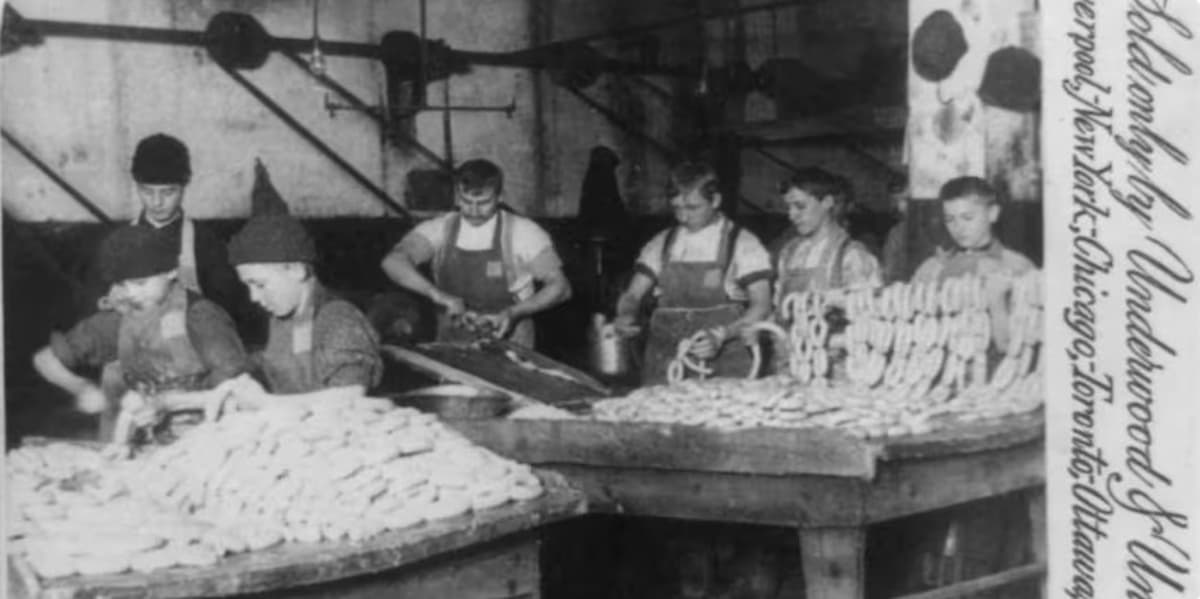
They read, in part, “Many inside rooms where food is prepared are without windows, deprived of sun-light, and without direct communication with the outside air…. Usually the workers toil without relief in the humid atmosphere heavy with the odors of rotten wood, decayed meats, stinking offal and entrails. The tables on which meat was handled, the tubs, and other receptacles were generally of wood, most of which were water-soaked and only half cleaned. The privies, as a rule, were sections of workrooms, enclosed by thin wooden partitions, ventilating into the workrooms. In a word, we saw meat shoveled from filthy wooden floors, piled on tables rarely washed, pushed from room to room in rotten box carts, in all of which processes it was in the way of gathering dirt, splinters, floor filth and expectoration of tuberculous and other diseased workers.”
A lot of the meat went into the sausages uncooked and unsterilized, and left overs would be swept up into a heap including dirt on the floor, then it was “ground up and used in making potted ham.”
The president decided not to publish that report, but in late May, Sinclair decided to leak what he knew about it.
“In Armour’s own establishment I saw with my own eyes the doctoring of hams that were so putrefied that I could not force myself to remain near them,” read a quote from Sinclair, and the report also read “the pillars of the building were caked in flesh. In these packing houses, the meat is dragged about on the floor, spat upon and walked upon.”.
June 30th, 1906, the Meat Inspection Act and the Food and Drug Act were signed by Roosevelt. However, the new law wouldn’t take effect until January 1907 and, even though it was an important achievement, Wiley believed it wasn’t strong enough. It defined adulterated food as product containing harmful, cheap substitutes or additives used to hide spoilage, and it outlawed making food from diseased, dirty, rotten materials or animals but it did not set clear standards for determining when food products were “injurious to health” and set no definition on what made a poison.
The third hygienic table trials were published in 1907, they were finding more and more preservatives imposing risks on the food supply. “The relations of sulfurous acid to health are perhaps of greater importance than those of the preservatives already studied- namely boron compounds and the salicylic acids and its salts,” Wiley emphasized the importance and need of well thought out regulations and manufacturers insisted its use was necessary.
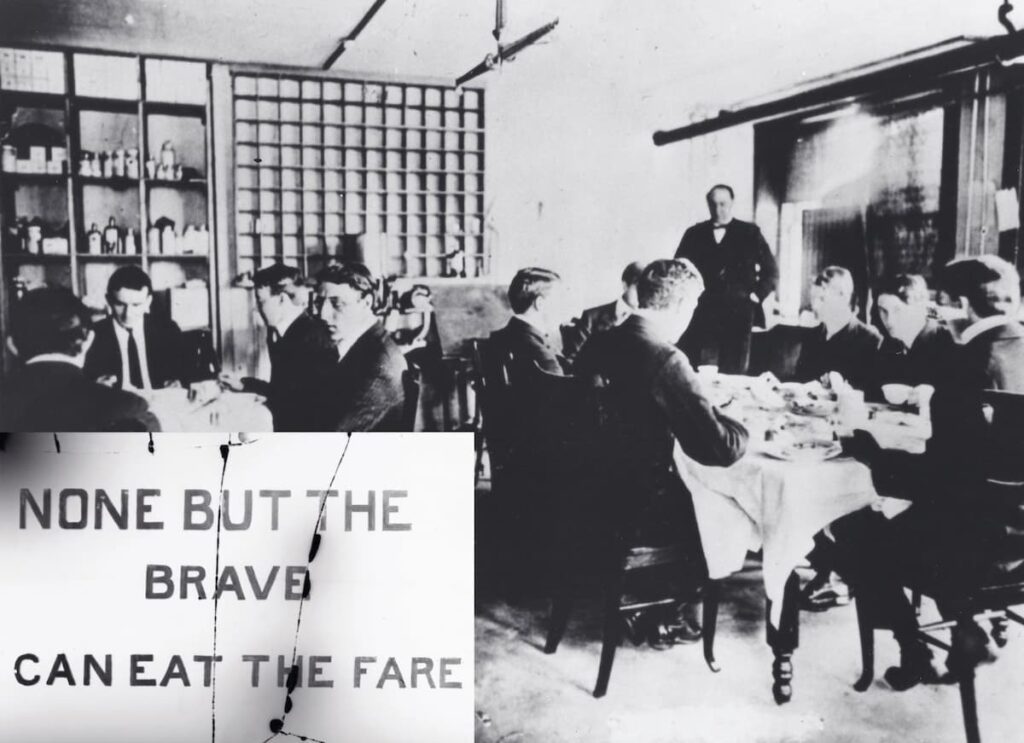
Sulfurous acid proved itself to be toxic, every volunteer reported a loss of appetite, stomach pains, headaches, dizziness, and feelings of weakness, two were pulled out before the tests could even end and they halted the trial. “The use of sulfurous acid and sulfites never add anything to the flavor or quality of a food but renders it both less palatable and less healthful,” Wiley wrote, “Every fact which has been brought out therefore in investigation tent to accentuate the justness of the conclusion, namely, that the use of sulfurous acid in foods should be suppressed.”
After the new law passed, whiskey companies with misleading labels were seized and prosecuted. Products advertised as rye whiskey contained no rye, as well as drinks made mostly from alcohol, coloring, and other harmful ingredients. Wiley argued that these products should be labeled as imitations rather than real whiskey and Roosevelt accepted a ruling for accurate labeling on whiskeys in April 1907. He also wanted all food and drink labels to list every ingredient, even the harmless ones, but conflicts on how the law should be enforced developed as officials disagree with the labeling of all ingredients.
Ketchup originally referred to different types of sauces made from ingredients such as mushrooms, walnuts, and oysters, tomatoes came into use in the 1800s but it was believed tomatoes were poisonous so it wasn’t as popular then. As popularity grew however, manufacturers used leftover tomato scraps, pumpkin rinds, apple pulp, and cornstarch to produce the ketchup. Also adding artificial coloring and sodium benzoate to approve the appearance and prevent spoilage.
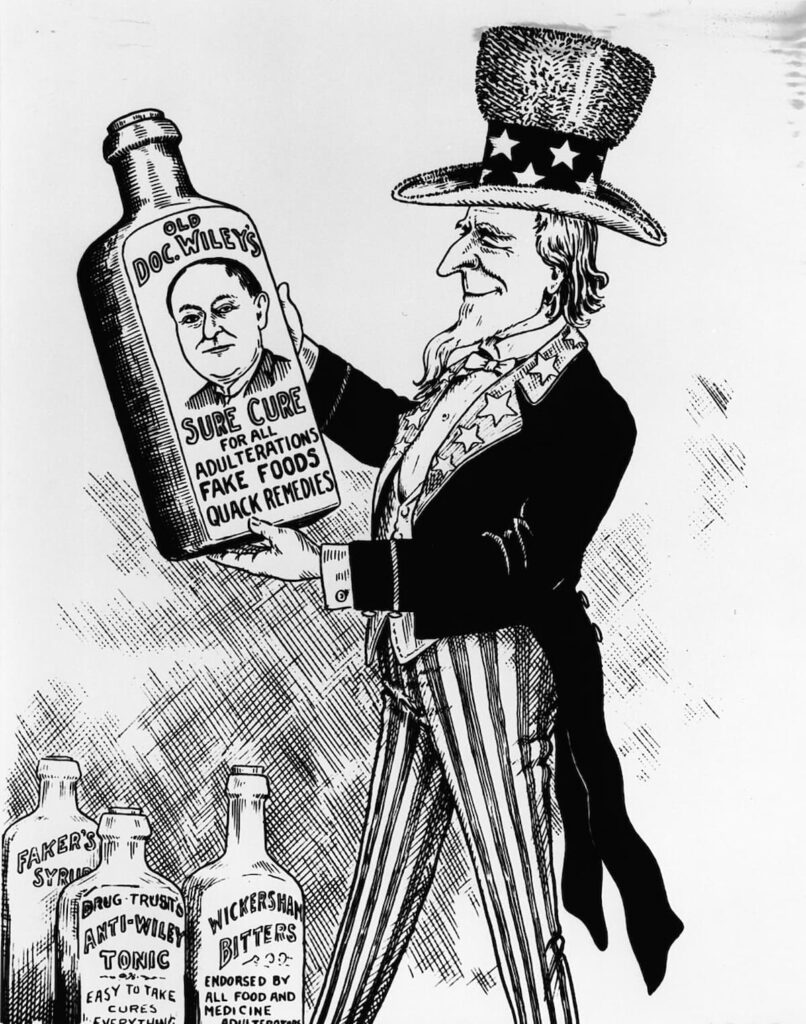
Wiley investigated sodium benzoate as he worried the preservatives allowed manufacturers to hide what was in the food. He believed ketchup could be made safely using fresh tomatoes, proper heating, clean containers, and a proper amount of vinegar. Henry Heinz took the recommendations seriously and developed a better ketchup recipe and by 1906 Heinz was producing a much thicker higher quality product, and even though it was more costly, advertisement convinced it was better quality and influenced how ketchup was made in the industry.
The National Food Manufacturers Association continued the fight against Wiley and argued he opposed modern food production but Wiley’s findings just proved his points more. The studies found that nausea, headaches, vomiting, and weight loss were common effects of the sodium benzoate. The researchers recommended keeping sodium benzoate out of all food products and Roosevelt agreed and stated, “Gentlemen, if this drug is injurious, you shall not put it into food.”
The chemists continued to research fraud in the food industry and found more dishonesty in regards to whiskey labeling. One brand contained only brown colored industrial alcohol, and another rye company had no rye in it, the industry wanted the president to accept these products but he continued to support accurate labeling and the efforts to protect consumers from misleading claims.
The concern for food safety grew for Wiley but the Agriculture Secretary James Wilson blocked reports that criticized the food industry. Several studies were delayed or canceled. Wilson advised Wiley against releasing his reports but somehow one was published in 1908 and advocates criticized the government for failing to protect consumers. Wiley argued that safe food was a scientific and a moral responsibility, in a vote of 42 to 15, the food and dairy agreed with Wiley on the issue of preservatives, “Resolved: That this association is convinced that all chemical preservatives are harmful in foods and that all kinds of food products are and may be prepared and distributed without them, and pledges its best efforts to use all moral and legal means at its disposal to exclude chemical preservatives from food products.”
White flour was a sign of wealth and status in the 1800s, this led to the increase of millers using chemicals to bleach flour, and the increase was quick. Nitrate residues were found in the flour from the nitrogen peroxide being used, and the residues remained after baking. The sale of bleached flour was banned in 1907 in the state of North Dakota by Wilson, but he gave millers a six month grace period to give them time to respond, in which the millers used that time to continue production and test whether the government would actually enforce the new ban.
The Hipolite Egg Company had 52 of their industrial-sized cans of eggs preserved in a solution of boracic acid seized, this company specialized in selling these cans at a much cheaper price to the baking industry, they’d repurpose dirty, cracked, rotting eggs for the use of bread and cakes. The process included taking decomposing eggs, mixing the contents into a thick mass using boracic acid, to halt decomposition, and then they’d sell the eggy soup by can.
The whiskey question was in the air again, “the term ‘whiskey’ should not be denied to neutral spirits diluted with water to a proper strength and colored with caramel,” read a document from a secret meeting to review the topic, the statement infuriated Wiley.
A new set of trials started on April 8th, 1909. Wiley reminded everyone the use of dyes was just to “make the article appear better than it really is, thus contravening the fundamental principles of the Food and Drug Act.” And he concluded “There is no hardship, therefore, in imposing the word “imitation” upon a beverage made in imitation of old genuine whiskey.”
Lloyd Bowers, Solicitor General of the United States, agreed with Wiley and ordered the dyed, flavored, and oil alcohol to be labeled “imitation”. But he also agreed that the blend of alcohols, if it was primarily whiskey, could be called “blended whiskey,” even if dyed to a darker color. If the dye was harmless, like vegetable dye, it would not be considered adulterated.
Wiley also wanted to ban sodium acetate from the use of candy, the sweets were largely consumed by children, he argued that sodium was a mineral and the clause banned the use of mineral additives, but Fredrick Dunlap, Wiley’s associate chemist, disagreed. He argued that if sodium acetate was a mineral then so was cane sugar, which “composed of over forty percent carbon and no one could possibly deny the fact that carbon is a mineral.”
“It must be evident that any drug used as a food preservative, eaten constantly, must affect the general health deleteriously and hence is most undesirable.”
– William Keen, Philadelphia physician
More than 100 medicated soft drinks and bottled water were on the market, Lomdarry Lithia made their drink with lithium and Coca Cola was still known for the cocaine used in its formula.
“Soothing syrups” were advertised to kids, they contained morphine, heroin, cough syrups, and chloral hydrate.
Medicated drinks were deeply troubling as consumers had no idea what substances they were consuming, and most of them were children.
“During the last 20 years, a large number of soft drinks containing caffeine and smaller or greater amounts of coca leaf and kola nut products have been placed on the market. Preparations of this class, on account of insufficient information, were formerly looked upon as harmless, but they are now known to be an impending evil,” was a review from the article “Habit-Forming Agents.”
Lymen Kebbler, a United Sates physician, found that almost every soft drink company would have a stimulant in their drink. The U.S government seized a shipment of Coca-Cola syrup in 1909 and a formal court hearing was scheduled, “United States v. Forty Barrels and Twenty Kegs of Coca Cola.”
Now president, William Taft, changed the rules for labeling whiskeys on December 26th. He ruled that any liquor made from grain alcohol could be called whiskey, as long there was an additional description labeling it if its a blend. However, products made quickly and artificially dyed would not have to be labeled an imitation. Alice Lakey, a progressive activist from New Jersey, wrote to magazines and newspapers following Taft’s decision, “We believe that Mr. Taft’s decision is the most serious blow to the pure food legislation this country has had… If this decision holds, it opens the door for every other product to demand the same ‘immunity bath’ … If we follow this reasoning when, then, should blackberry brandy contain any blackberry juice? … This decision robs the consumer and the honest manufacturer of the protection designed by the pure food law.”
625 sacks of bleached flour were seized from a Nebraska company, the millers fought this in court. They argued that the bleaching did not degrade flour that it enhanced it, they argued that since nitrates and nitrogen peroxide were products of nature and claimed they weren’t unsafe or injurious. “The fact that poisonous substances are to be found in the bodies of human beings, in the air, in potable water… does not justify the addition of the same or other poisonous substances to articles of food, such as flour, because the statute condemns the adding of poisonous substances,” the jurors declared that bleached flour was both adulterated and misbranded.
“Eight Coca-Colas Contain Enough Caffeine To Kill,” The Atlantis Georgian announced.
The “United States v. Forty Barrels and Twenty Kegs” trial began. It focused on the drinks manufacturing process, the name, and its caffeine content. The government argued the name “Coca-Cola” was misleading as there was no coca leaf or kola nuts in the formula anymore. Inspectors reported unsanitary production conditions, finding dirt, straw, and insect parts in the syrup.
The scientists also testified that repeated caffeine consumption could cause physical health problems, affect the nervous system, and lead to a dependence of the substance. Coca-Cola defended its practices and hired psychologist Harry Hollingworth to study caffeine’s effects, and his tests revealed that the caffeine would briefly improve reaction speed and performance without measurable harm. The judge accepted Coca-Cola’s response and he dismissed the case.
Fakery and adulteration were still at large. “Cordials containing artificial color without declaration… figs unfit for consumption because of worms and excreta… flour bleached to conceal inferiority, eggs decomposed and unfit for food, arsenic in baking powders [also in gelatin and the shellac used to give chocolate a shine], so-called egg noodles containing artificial color but little or no eggs… black pepper containing added pepper shells, maple products adulterated with cane products, confectionary products containing talc and unpermitted colors, mis-branded mixtures of olive oil and cotton seed oil,” read a report to Secretary Wilson.
“Soda Water Sold to City Children Is Full Of Poisons” read a series in The New York Globe.
A chemical analyst had found that many fruit syrups maintained anything but fruit, they were mostly alcohol, glycerin, acetic acid, succinic acid, benzoic acid, and coal-tar dyes, as well as heavily sweetened with unlabeled saccharin.
A business friendly decision was made in February 1914, the nitrates leftover in bread could not be considered poisonous residues unless the government could prove it was directly harming consumers. The justices had found in favor of the millers, and not only that, they had set an extremely high standard on what constituted an additive injurious and the banning of it.
The following years, however, the Agriculture Department and the millers would finally agree on three things; bleached flour had to be labeled as such, the government would withdraw the charge that flour contained “deleterious” compounds, and the millers would accept the original charge of misbranding their flours.
Chief Chemist Alsburg challenged the St. Louis Monsanto Plant for falsely labeling saccharin as “harmless” and “healthful”, and at the same time the battle over caffeine in Coca-Cola was still going on.
That finally settled in 1917 though, Coca-Cola agreed to reduce its caffeine levels by half and allowed the case to be settled.
December 1919, the case against saccharin went to court, officials argued that the sweetener was used in almost all foods and drinks and used without consumer knowledge or restrictions of consumption, which could be dangerous. Monsanto argued that the government had not clearly proven that saccharin caused harm, making it difficult to restrict use. The legal battles proved the weakness in the 1906 Pure Food and Drug Act, it required ingredient labels but did not prevent mislabeling and misleading packaging.
It also did not require manufacturers to state the amount of product inside containers, and efforts to pass a stronger law failed because of the manufacturers’ opposition. The saccharin case ended in a mistrial. The government eventually stopped trying to ban sweeteners, but they did require manufacturers to list saccharin on product labels and warned against its use.
The Agriculture Department split the Bureau of Chemistry into two in 1927. The Food, Drug, and Insecticide Administration was created to handle consumer protection duties, and the other division was focused more on basic agriculture research, the Bureau of Chemistry and Soils. Three years later, in 1930, the Food, Drug, and Insecticide Administration was renamed the Food and Drug Administration. Walter Campbell, now the head of the new FDA, continued to fight for stronger food regulation.
The Food, Drug, and Cosmetic Act of 1938 greatly expanded the 1906 legislation. It gave the FDA and larger authority and was established because more than 100 people died due to diethylene glycol being found in cough-syrup. Following this, a 1956 decision to ban all coal-tar dyes was because children became sick after the consumption of Halloween candy. One law after the other was being signed because of outbreaks of illness or sometimes death due to food. Peanut butter made by the Virginian-based Peanut Corporation had allowed its factories to go unregistered to avoid government attention. Many of the jars contained salmonella and the product was linked to 9 deaths and 22,000 illnesses. The FDAs authority was expanded again in 2011, including new requirements that the food processors followed specific safety practices and kept records.
The passing of the Pure Food and Drug Act did not end the fight for food safety. Wiley, his team of chemists, and the scientists that followed helped expose harmful additives, misleading labels, unsafe practices when it came to producing the food, and continued to develop food safety laws.
Despite all the work however, we are still fighting for food safety in 2026. The FDA has reported recalls for foods that contained salmonella, listeria, and more undeclared milk allergens in several foods and drinks in October 2026. Although regulators had greatly improved, contamination and mislabeling still poses a risk to us consumers today. More than a century later, the fight for food safety is still very important to the health and safety of Americans.