
 juno Rylee Stump-Schultz
“I’m so warm and calm inside; I no longer have to hide.”
This issue of GIRL MUSIC is different than the rest; it’s still about an artist, but this time it’s me.
» Consider buying me breakfast or coffee on Ko-Fi/PayPal, or leaving me a small tip on Venmo.
« Contact me at juno.rylee.schultz@gmail.com if you need someone with experience in mock reviews, copy editing/writing, PR work, etc »
Words, research, and edits: Juno Rylee Schultz (she/her)
Research: Kylie Tuinier (she/her)
Edits: Bex Stump (she/her), Kylie Tuinier (she/her), and Nathan Miller (he/him)
What does feeling safe look like to me? I had never been asked this question until I was in group therapy in an outpatient mental hospital program.
I had never even considered what safety looked like. I was too busy looking around for security constantly, without knowing how to actually feel safe, regulated, and have inner peace.
I’m no doctor. I only have my own experiences, and everything I can learn from them.
But I’m pretty sure I was manic for the last five years, and before that, I was grasping at my life, wishing, waiting, and hoping for the pieces to come together.
I grew up with different parents than I have now.
From age four through age seventeen, I experienced non-stop abuse. Much of it emotional and physical, and I never had a moment of reprieve or peace, even when I was by myself.
I was forced to pretend to be a boy from as early as I can remember. My first memories I can place are from age four, and I remember screaming and begging God and anyone listening to please help me fix my body.
My first suicide attempt came around age five. I was painfully aware of my lack of hips and how my legs lacked the shape that girls and women around me all seemed to have. I thought a knife, or some scissors, something sharp, could help me correct the shape of my legs.
I figured worst case scenario, the doctors who saved my life–after I attempted to carve my legs into the right shape–would listen to me more than my biological parents.
My life kept getting harder, and worse, because that’s what happens when you’re abused and don’t feel like you have any control of your life.
I don’t really want to go through all the traumatic things that happened to me, so let’s just say that I was physically and emotionally abused by most of the adults who were supposed to keep me safe, and I was sexually abused by a few people who I thought were friends.
I was abused further by a girl I dated right before I got with my current partner–my wife–and if I didn’t already have Borderline Personality Disorder by that point, then I definitely got it from that other girl.
When I was 28 years old, I found Dana. My Momma. My real Mom. My found Mom. My actual Mom. It was then that, with the help of my Mom and family, and my wife and her family, that I was able to transition and start … living.
I found this extremely difficult despite me finally being free to authentically live and express myself. I never had the tools growing up or any resources to know how to do anything.
All I knew up to that point was that I was a writer, and how to cope with my life and trauma.
It took me a few years to take my Mom’s advice and have people with more qualifications than a therapist try to help me with my trauma and problems.
I had all the love and security and safety in my life. I knew my Mom and family weren’t going anywhere. But I still had these gaping emotional holes in me from where life was meant to happen, instead of increasingly traumatic experiences.
Cut to Summer 2026 and I finally was coping unsuccessfully to the max.
I couldn’t swallow food due to a sensory processing disorder with my ARFID.
I couldn’t stop having 24/7 panic attacks.
I couldn’t breathe without panicking.
I had shortness of breath but it was all from my emotional tinnitus.
I checked into an inpatient mental hospital. I didn’t know it at the time, but this place would barely help me, and mostly just traumatize me further.
The first night I just cried into my pillow. I skipped meals and just sobbed in my bed the next day.
I called my wife, my Mom, and friends, and I just cried into the phone while they told me they loved me and that it was going to be okay.
I think this was all the help I really got from that place to be honest, other than getting onto a few medications, and learning that if I surrendered to my problems, and tried to get help, everyone who loved me would be there for me.
I gained a lot of help from the eating disorder groups at that hospital, but otherwise I just played the game and said the right things to get discharged.
I recognized this place was causing me stress and problems, especially after the hospital staff told my roommate I was trans, which caused her to want to kill me. Then my paranoia was just worse while that girl yelled about how she wanted to kill me from the hallway.
A few days later though, I was discharged. I was on some new meds.
And I was back to coping on my balcony with my weed, cigarettes, and Coca-Cola.
After a few weeks of non-stop panic attacks and being unable to eat, I told my Mom and my Wife it was time for me to get back into a hospital for help.
My therapist recommended inpatient care again, or outpatient care.
I was anxious about it since my first experience with being committed went so poorly, but I also wanted to get better and knew it was the only way.
The next day my wife took me to the mental hospital for intake, and they approved me for outpatient, half-day care. Since I wasn’t actively suicidal and was just struggling a lot, I didn’t have to go inpatient care this time.
I was extremely skeptical of the entire process. I probably would have been skeptical regardless, but my previous attempt to get better at the other hospital also informed my doubt.
I had been managing my Borderline Personality Disorder, and doing my best with eating, but I just knew I needed more help.
I surrendered to the possibility of getting better. I let go of my fear, my doubt, and my fear that I would never truly get better.
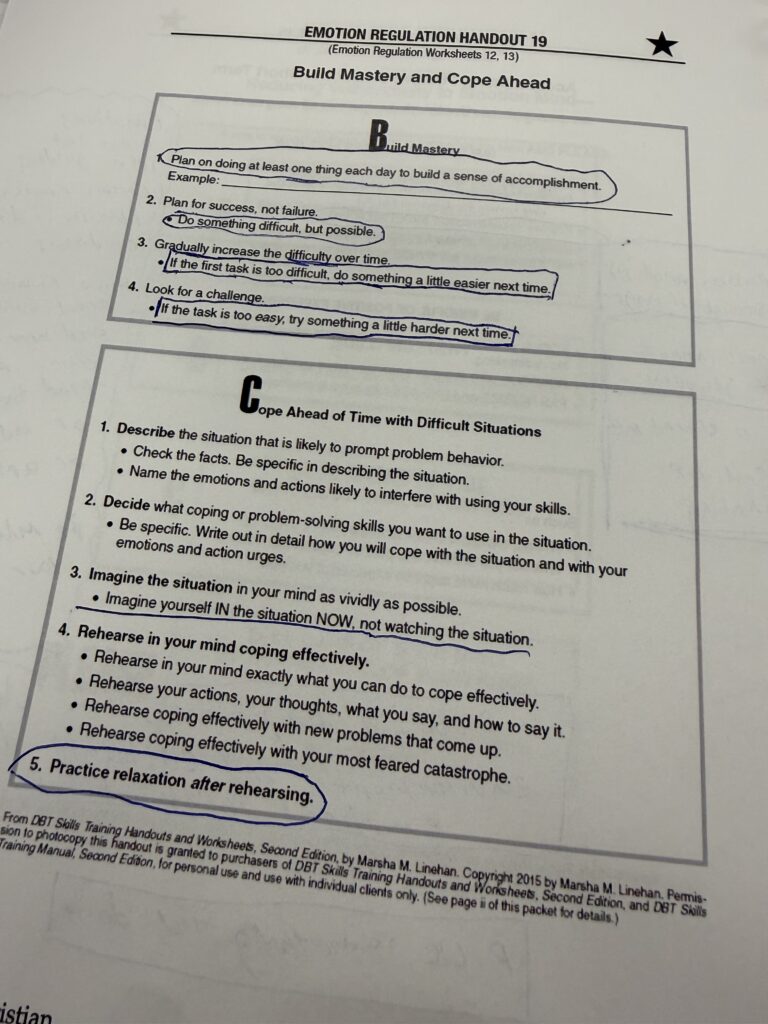
After about a week of outpatient care, I can confidently say that this place has given me the pills and skills I needed to function fully and properly.
I know it sounds strange, but I genuinely think I was either manic, or locked in fight-or-flight for the last 30 years. And now I just feel like I’m simultaneously a baby who was just born, as well as a 20 year old who just woke up inside of a safe forest.
I am behind because of my abuse and age regression, but I am growing outside of a panicked or manic state of mind now.
Our problems in life can all be so different, but fortunately a lot of the solutions can work for so many of us, regardless of where we came from, and so I would like to talk about what’s helped me during outpatient care, and how I’m healthily managing now.
What does feeling safe look like to me? For me, feeling safe is knowing I am loved unconditionally, and knowing I will be okay even when my emotions distort my reality into me feeling otherwise.
I learned that the brain changes from trauma. The amygdala functions as the smoke alarm in your brain, and the more it is used, the bigger and more active it gets. The brain’s pathways get worn in the paths used, much like when we create trails in the grass from taking that path over and over again.
I learned in outpatient care that the hippocampus shrinks after trauma, making it less effective at managing emotions and memory processing. It gets worse too. As we attempt to process old trauma, the hippocampus and amygdala react as if the trauma is happening right now.
Then these painful thoughts and intense emotions repeatedly continue to change our brain over time.
The elasticity of the brain strengthens the pathways that are used, but it can be undone.
Mindfulness reverses the effects of trauma. Mindfulness brings us into the present, processes it, and shows us what is actually happening in our lives.
It begins with our values and our boundaries, since it originally began with our values and boundaries not being respected. That’s where the trauma comes from; us having our sense of self and safety consistently rejected.
For me, my sense of compassion, my sense of love and feeling love, and my admiration for growth are some of my core values. And this is why being forced to boymode, being hit and thrown, and being sexually abused disrupted my sense of self and safety so much.
During all of that trauma, I not only didn’t know how to process it, but I also began to accept the traumatic events as a normal part of life, which locked me in a state of constant panic.
I didn’t feel safe inside, and so I wasn’t safe inside.
Even though on the outside, I was safe.
Once you’re safely away from abusive situations that compromise your safety and self, you can identify your boundaries, your values, and what makes you feel safe and loved. Then you can build those foundational support beams in your life.
People pleasing behavior and having no set boundaries can lead to low self-worth and resentment. We need to learn and understand that there is nothing wrong with telling people “no.”
In fact, there’s power in those words. Saying “no” to someone is an act of self care. It isn’t toxic or selfish to identify your needs.
However, we need self awareness to untangle our emotions from the emotions of others, so we can properly act on our emotions, and know what we need for safety and security.
The best place to identify your needs and practice how to protect them is by journaling. Practice voicing your opinions privately over a pen and paper so you know what you need and how to express it more confidently. It’s a bad idea to identify your needs when they’re questioned in the moment because there’s the danger of not knowing what you need, and subconsciously buckling to the needs of others over your own.
Boundaries can only be set with aspects you have some control over so it’s worth planning for situations where you may feel like you lack more control than you would like. Another way to help with this is to “cope ahead” of a situation.
By acknowledging what can’t be changed, and preparing for situations, we can plan for the parts we can control, and we can make a plan for what we cannot control.
Radical acceptance is also important for mindfulness, because it means accepting reality as it is.
There are limitations on the future for all of us, but life can still be worth living even with painful and uncomfortable parts. In fact, by accepting reality, we can identify the parts of reality that can be changed. Rejecting reality keeps you stuck and doesn’t allow for any aspect of change.
The radical acceptance of a situation may initially lead to sadness, but a deep calm often follows. This is because radical acceptance is starting to climb out of a spiral, instead of remaining at the bottom of all your problems.
I learned from group therapy that pain and resistance just lead to more suffering, but that pain and acceptance leads to healing and changing what can be changed.
Mindfulness is bringing ourselves into the present, allowing us to accept what can and can’t be changed, and leading to peace and radical acceptance.
One method for mindfully regulating your body and mind is by tensing and untensing muscles in an organized order. You can start from the bottom and move up, or from the top and move down. You just do 10 second breaths through your nose, hold, and then exhale through your mouth, all while tensing and untensing muscles.
And it’s during these exercises we can sort and manage anxiety and uncomfortable feelings.
There is facilitating anxiety, which is productive and useful, and then there is debilitating anxiety, which is destructive.
While doing mindfulness exercises, we can list and sort these different anxieties, so we can manage what can be controlled, while letting go and accepting all that cannot be controlled.
You can’t properly live your life without mindfulness, because it is within the chaos of an unregulated body and mind that suffering is created. We can’t even access our full brain functionality while dysregulated. When the amygdala is activated and that smoke alarm is going off, it’s much more difficult to access the prefrontal cortex.
If we want to access the fullest versions of ourselves, without the mask and chaos, then we need to practice radical acceptance and mindfulness.
Mindfulness and neuroplasticity can fix and improve the damage from trauma in the brain. Over time, we can reverse the effects of trauma; it just takes time and practice.
Our emotions can help guide the logic of our mind, as long as we sort through what is real, and what is created from trauma and stress.
I think the most important time to start with mindfulness and regulation is when we first wake up. In fact, if we don’t, we’re at risk for a rough day, since our day technically begins with biological stress.
Cortisol is what our body uses to wake us up, but this is also a stress hormone.
When we first wake up, it’s important to ask ourselves how we are feeling, and to sort our stressors between facilitating and debilitating, so that our stress doesn’t steer us and our outlook.
Our emotions are extremely important, but so is the logic and facts that we know are true.
The best way to think of emotions is like they are ocean waves. Emotions can be uncomfortable but emotions are not good or bad. It is what we decide to do with our emotions while processing them that determines their direction and purpose. We can surf on top of the waves, swim through them, or drown.
Naming our emotions can also help us tame them. If we understand why we are feeling the way we are, we can steer through it without being trapped in a storm. Shoving emotions underwater only makes them stronger before they pop back up like a beach ball shoved underwater.
The more we avoid our feelings, or any situation, the more they are able to control us.
Inner peace comes from processing emotions, accepting life, and making conscious and informed decisions with our entire mind.
By meditating and regulating with curiosity instead of judgment, we can recognize why we feel the way we do, and meet life’s challenges with our “wise mind.”
The “wise mind” is at the center of emotions and logic.
My social worker said to think of your emotional mind as the gas pedal, and your logical mind as the GPS. Both are necessary to go, and neither is more important than the other.
It’s about identifying and balancing them both.
If we take the emotional mind and the logical mind, we get emotions and facts, which are everything you need to mindfully succeed and proceed.
An easy way to access your wise mind is to combine two statements from both parts.
For example, “I feel anxious about …” and “I know it will be okay because …”
In these two sentences we are acknowledging our emotions while responding to them with the logic and facts we also carry.
My life has been filled with tragedy and pain, but my life has also been filled with dreams coming true. I grew up abused without love, but I’ve since found love, my family, and myself.
Our lives and traumas are all different, but I also genuinely believe that if I can get out of my panicked and manic state, after decades of being locked up with grief, pain, and fear, then anyone can do it.
Life is really hard, but it’s even more beautiful.
I can see the future now. I can see myself now. All I have to do is close my eyes and regulate. I now fully know I am going to be okay, even when my emotions or life feels intense. I know how to manage now and how to remain mindful.
It will take time for my brain to heal, but it gets easier every single day, now that I have the right pills and skills to feel okay and present in my own life.
If you or someone you know is struggling with suicidal ideation, or managing their day to day life, please consider getting help. I didn’t think anyone could help me except my Mom, Dad, and my partner, but I was happy to be mistaken after giving a hospital a week of my time.
I can breathe now, and the blurry panic of everything is finally gone.
I believe in you and I know you can heal your brain too.